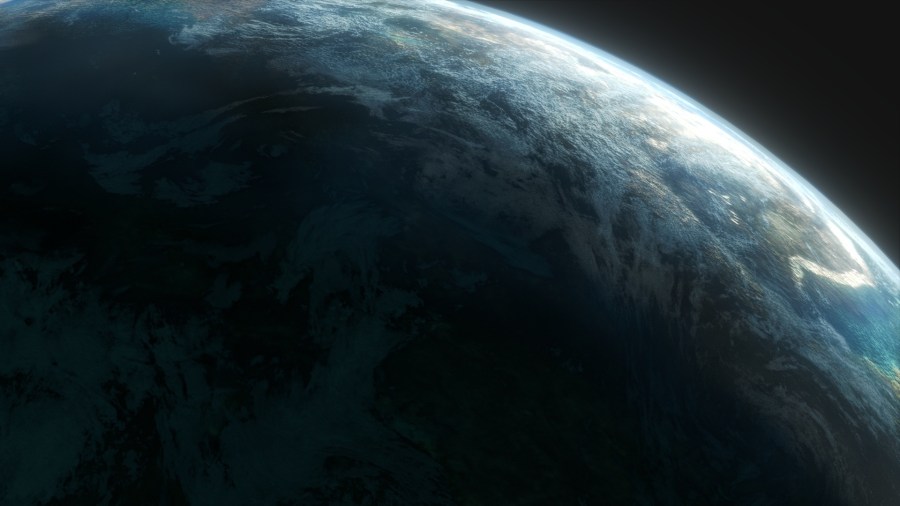
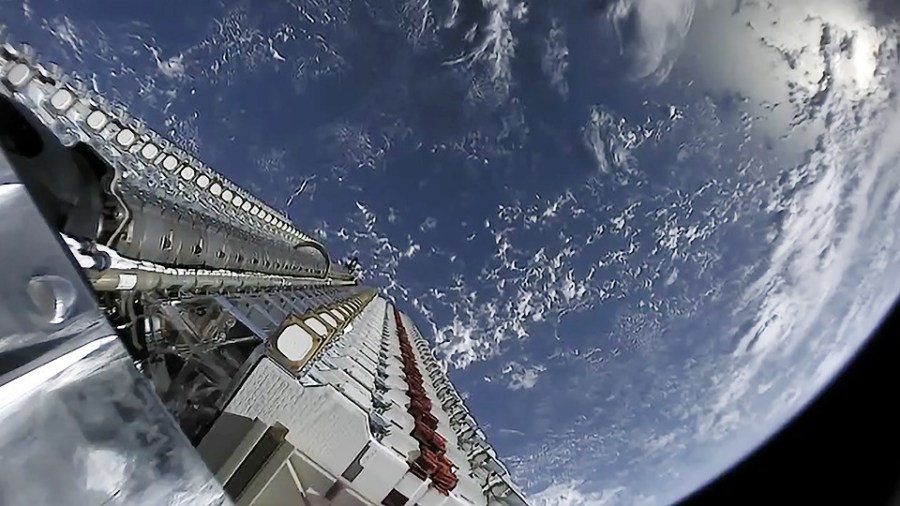
The island rapidly dwindled with distance below them, the sparkling sea stretching away to distant horizons in all directions, while the sun hung low to the west in a blaze of fiery orange and pale yellow. Directly overhead, the sky quickly took on a deep blue tone, set against the now familiar pale turquoise to north and darkening east. Other mountainous island chains dotted the sea in the distance, tiny, as if on a relief map.
Acceleration pushed at them all floorwards, but only gently, and only for a few minutes. Ca-Tren squawked in surprise and wobbled on her feet, Laxmi and Jaci both squatted slightly and reached to the low furniture for support, while Anna held onto the main control console. After the initial rush, they all found their feet, and in less than five minutes the acceleration eased and the cabin assumed a constant, smooth, and noiseless velocity as it climbed the interior of the cable.
Last week I mentioned I had one more scene ready to go, and here it is. What’s more, the next scene is already written, too, so you may fully expect that one next week. Wow, three scenes to be published with only a week between them? What is the world coming to? More to the point, will I be able to keep it up? That, my friends, is a bigger question.
Last week we left our heroes having just started the alien space elevator on its upward journey, as Anna whispered to herself, “Next stop, orbit.” So just how long will this ride take?
Remember, the other end of the ride is the ring station, which is at geostationary orbit, 41,000 kilometers above the ground. That’s pretty high up there. By contrast, back here at Earth the International Space Station orbits a mere 400 km high, so we are talking an altitude a hundred times greater. Why so high? Because this is the altitude at which the angular velocity of the planet’s rotation matches the required velocity to maintain a constant state of free fall, or in other words, a stable orbit. Remember, the greater the altitude, the less velocity is required to maintain orbit. At 400 km, the ISS zips along at about 17,000 miles per hour in order to stay in orbit, which is pretty fast. At 41,000 km, the ring station orbits at closer to 6,700 mph (3,000 meters per second), still really fast, but quite a bit slower than the ISS. And, it has to move at this speed, because this is how fast the elevator cable is moving at that height, since it must remain stationary with respect to the ground.
So, the elevator cab, or more precisely, the climber, has a long way to go. How fast it can climb the cable is determined by a number of factors, not least of which is not crushing the passengers with acceleration. In fact, in order to keep the ride comfortable, after the initial acceleration, the climber will maintain a consistent velocity, so it won’t impart any additional g-forces on the passengers beyond what the planet’s gravity provides.
Gravity doesn’t just fade away in orbit, by the way, at least not until you get much farther from the planet. In low orbit, where the ISS flies, the astronauts on board are still subject to about 90% of the gravity we feel here on the surface. The difference is that they are forever falling, with the station itself, but they are falling fast enough that they keep missing the earth and instead curve around it, endlessly (subject to a slight atmospheric drag and inevitable entropy).
So our elevator passengers feel gravity, and while it will eventually become somewhat less strong as they ascend, they won’t really notice, at least not at first. Instead, the higher up they climb, the faster they, and the climber, and the cable, are moving laterally in order to maintain rotation with the planet. They won’t be in free fall until they reach their destination, at geostationary altitude, but they will gradually feel lighter on their fee right up until that moment.
Ok, back to the speed of the climber’s ascent. We’ve established that it shouldn’t go so fast as to cause discomfort to the passengers, but it also shouldn’t go too fast or it might impart undue stress on the cable itself. The faster the climber moves, the more lateral force the cable must impart upon it to keep it rotating around the planet, which will tend to precess the cable westwards due to coriolis forces. Too much force, and the cable could break, and that would be bad.
We also don’t want to go so slowly, however, that the journey becomes impractical for how long it takes. We need a happy medium. How about as fast as high speed commuter train, or perhaps just a tad over that? This seems to be a good compromise, and we arrive at about 300 kph. That’s pretty fast, too, or it would be for an object on the ground. At 300 kph, the climber will reach the same altitude as the ISS in just about an hour and a half. That seems pretty good!
But remember, we’re going a hundred times higher than the ISS.
This journey is going to take about five days.
And that, my friends, is why the climber is stocked with a bar.
Anna peered through the open doorway into the elevator cab interior, no longer dark, but now well-lit. The low seats and couches they had observed earlier through the window appeared surprisingly comfortable, a far cry from the stone benches of Ar-Danel, each accompanied by a side table and small console. Surviving cushions remained mostly mold-free, if a bit thin and stiff. A musty odor persisted, surprisingly mild given the centuries this chamber had remained sealed up, disused. Along the convex back wall, next to one of the closed doorways, an alcove sported what to Anna’s eye appeared like nothing so much as a bar. After so many weeks of effort to get to this place, weeks of intense focus upon this singular goal, she finally felt she could relax just long enough to let the wonder of where she was wash over her.
A working space elevator! Well, it remained to be seen if it was fully operational, but the signs so far were encouraging. After some experimentation, Anna and her crew had deciphered the written labels for power, light, and ventilation, and possibly also the color codes for more or less temperature. Some of the other labels remained a mystery for the moment, though she suspected she knew which ones were probably indicators for up and down, concepts Ca-Tren certainly understood, but perhaps these were written with more technical terms.
Laxmi pressed past Anna into the cab, a bundle of gear in her arms which she added to the pile of their equipment already moved inside. A sense of bemusement displaced Anna’s wonder and awe. Laxmi was now the impatient one, eager to move forward, while Anna wanted to study the alien technology, now that they had powered it up. Then her bemusement gave way to concern.
Hey ho, my hearties! I’m just back from a three-week cruise, sailing around and among the famous San Juan Islands in the Pacific Northwest, arrr! No doubt you’ve missed me, eh? I’ll post a photo or two for you shortly. Meanwhile, though, the good news for you is that while I was lounging around on the boat, I put fingers to keyboard and tapped out two more scenes, the first of which is linked just above. So quick, go click that link and read it! And rest assured the next one is already written, and I’ll get it published here in a matter of a few more days or so.
By now you know, of course, that Anna and her crew have figured out how to power up the space elevator, or at least the cab and the departure lounge, even if they aren’t always sure what the next button they press (or dial they circle) will do. It’s all a grand experiment, and Anna just hopes it won’t go boom in their faces, or more likely, under their feet. But before they can head up the long stalk to geostationary orbit, they are going to have some tough decisions to make. Life isn’t all sunshine and roses, and there is that musty smell coming from somewhere.
So go spend six minutes reading the scene, then drop me a comment and let me know what you think. Meanwhile, I’ll be getting the next one ready…
Most writers want to have their work read. After all, that’s why we write, no? Ok, some folks write purely for their own catharsis and don’t care if another soul ever sees it, or perhaps don’t even want anyone else to read it, and some write with the (elusive and probably misguided) goal of making money, but most of us write simply because we enjoy seeing others enjoy our work.
And for that to happen, we have to be noticed. People have to be aware that the work exists and know how to find it, or it won’t matter how amazing the writing is, how engaging the story. It will languish in the darkness of obscurity.
There are many ways to be noticed, some more effective than others. We’re all trying to find those magic keywords that will maximize our search engine optimization, or SEO, and somehow draw readers in out of the ether, and yes, we find some readers that way. We promote our work on social media, engage with others in hopes they’ll engage with us, and yes, we find a few more that way.
But unless we’re already famous, that rarely turns into more than a trickle of readers. In fact, being too aggressive with self-promotion on social media is likely to have a negative effect, turning off potential readers who just want to engage in friendly chat and not see what amounts to endless advertising all day.
So it may seem almost counter-intuitive, at first glance, that advertising may be a way to get over the hurdle of not overly aggressively bombarding our friends and followers with, well, advertising.
What do I mean by that? Well, at the time I write this, I have just barely over a thousand followers on Twitter, and just barely under a hundred on Facebook. It took me four years to get to that point, though some people seem to manage it overnight, but I refused to play the various “follow-for-follow” games, mainly because they turned me off when I saw them, so I presumed they would turn off other “real” engagements as well. If all I do on Twitter is constantly push my writing to my existing followers, I’ll probably start losing more than I gain. And in any case, most of them will never click that link through to my website, even if they like the post in which I share my latest scene.
Still, at first glance Twitter seems to have a ten to one advantage over Facebook in terms of my reach toward potential audiences. That is probably offset, however, by the nature of those who follow an independent, unpublished, non-famous author on one platform vs the other. The majority of those who follow me on Twitter are other writers, some published, some not yet, some represented, and others not. They are there for the same reasons I am, yes, to promote their work, but also to engage with likeminded people going through the same struggles they are. In other words… not the general reading audience, but more like a professional association.
Facebook has far fewer people following me, and while many of those are also other writers, there is (I think, it’s hard to be sure) a higher percentage of them who are “ordinary readers” who are interested in science fiction. Still, the organic engagement I get with a tweet vs a Facebook post reflects that ten-to-one split, and so I’ve tended to focus more of my time where the greater number of people reside.
A recent experiment might imply that I’ve been focusing on the wrong platform.
I ran an ad on each of the platforms to see what would happen. No, I don’t have anything to sell yet, so there’s no financial incentive for me in this. It was just to see what kind of engagement I could drive with my story as it develops here on these pages. I ran them separately, with about a week in between. I posted precisely the same link on each (this one, here: The Silence of Ancient Light), using the same language and same tags (#ScienceFiction and #WIP). I targeted the same countries (United States, United Kingdom, and Canada), and targeted audiences interested in Science Fiction and in Reading, but otherwise left the demographics wide open. I gave each an identical budget of $50. The Twitter ad ran for 5 days, and the Facebook one for 7 days (the defaults on each), but the majority of the results from the Facebook ad still happened within those first 5 days, so this was roughly equivalent.
Twitter Advertising
On Twitter, the ad received a total of 3,288 impressions, of which 2,670 were “promoted” and the remainder were “organic” (happened naturally, and would likely have occurred without paying for the ad). An impression is just the ad appeared before someone’s eyes, in their feed, whether or not they interact with it at all. Those impressions resulted in 90 total engagements, of which 83 were promoted and again, the rest were organic. That’s a 3.1% engagement rate, which by all accounts is about as much as you can expect. An engagement is someone taking any action on the ad: 32 people expanded the detail to see the full text, 24 people clicked the like button, 15 people clicked on my profile to learn more about me, and 10 people clicked on the link to follow through to this website. 7 people retweeted the ad, and I gained 2 new followers because of the ad.
Since “link clicks” was the real purpose of the ad, that means 0.4% of people who saw the ad clicked through to the website. Less impressive, perhaps.
Meanwhile, over here on the website, during the time period the ad was running, I saw those 10 views on the page that was the ad’s link, though only 9 of them were registered as being referred from Twitter. Overall, the entire site had 35 views from 18 unique visitors, and I received 1 post like. This implies I had almost as many organic site visits as I did promoted visits, which may partly be explained by me having posted a new scene to the site a few days before the ad began running.
The ad reached 2,670 people, and 0.4% of those clicked through to read the “title” page of the story. A small handful of those 10 people then clicked on to read one or more actual scenes of the story. So, that cost me $10 per reader, and they weren’t very engaged by the story. Perhaps the story is just bad?
Facebook Advertising
A week after the Twitter ad expired, I ran the same ad on Facebook, as I described above. With few exceptions, everything about the ad was identical.
The Facebook ad reached 12,812 people, of whom 12,807 were paid and just 22 organic. Right away, we see that Facebook seemed to have much greater reach, nearly 5 times as much. But what about engagement?
991 people engaged with the ad. I don’t have the split for paid vs organic on this number, but as I have very few followers here, and only a single-digit number who ever seem to engage with my regular posts, I feel safe in saying that the vast majority of this number was due to the paid ad. That’s a 7.7% engagement rate! More than double the engagement of the identical Twitter ad. Of those 991, 48 “reacted” (clicked like, mostly, though one hit the laughing out loud button, and I’m not sure what to make of that), 6 shared the post (1 of those was a share of a share, so while not exactly viral, that is how those things get started), 1 commented on the post (and it was a strange comment, so not necessarily a positive), and 934 clicked on it. Of those clicks, 367 were clicks on the link to this website, and 567 were “other” clicks (on my profile, perhaps? it’s not clear).
Back here on the website, I tracked 384 Facebook referrals during the time the ad ran, and 901 views from 333 unique visitors. There were 391 views on the promoted page, and 1 page like.
The ad reached nearly 5 times as many people as the Twitter ad, and 2.9% of them clicked through to look at the website, compared to 0.4% of those who saw the Twitter ad. Instead of $10 per reader, this campaign cost me 15¢ per reader. That’s much more effective!
There’s an even more compelling stat here, however. From the Twitter campaign, only a handful of people read anything other than the initially linked page. From the Facebook campaign, about two dozen people went on to read at least the first few scenes, almost a dozen read quite a bit more than that, at least through the first few chapters, and at least 3 people read the entire story so far published, all the way to the end.
That tells me that it’s not just the advertising, but my writing is engaging at least some people. Not all, perhaps not even a majority of those who look at it, but at least some are finding it worthwhile to spend several hours reading 80,000+ words.
It is curious, however, that no one from the Facebook campaign chose to become a new follower of either my Facebook page nor this website. They read through all the work, which is as yet unfinished, but did not click the link to sign up to be notified when the next scene is available. I’m going to presume they bookmarked the site in their browser and will just periodically check back — maybe? — but perhaps I need to investigate why people are reluctant to hit that “follow” button. I have some thoughts on this, but no real data.
Next Steps
Needless to say, this is encouraging. I’ll continue writing as long as anyone continues reading. For the sake of being thorough, I should also do an identically configured Google AdWords campaign to see how that stacks up. I haven’t yet decided if I’m ready to spend another $50 to find out, but maybe.
Otherwise, is there much point to advertising when I don’t yet have a finished book to sell? Obviously I have no way to turn that investment into any kind of revenue, not yet. However, it never hurts to generate some buzz around the unfinished work, so that people are eager for the final publication. I can’t say if I really achieved that, but I did get my work in front of quite a few more people than I ever had before. And, I have some thoughts about where to focus my investment when I do have a book to sell. Indeed, this experiment turned my expectations upside down, as I had been led to believe that Twitter would be the more effective platform, yet the reverse was true, and by an entire order of magnitude.
Other than more advertising, this experiment has encouraged me to post more often on Facebook and become more engaging there, whereas previously I mostly only posted there when new scenes were available. Twitter had been my “engagement” platform of choice. I will definitely still engage there, but I will broaden my horizon a bit.
What do you think? Did you see the ad? If so, on which platform? Did it cause you to click through, and is that why you’re here now reading this post about how I manipulated you into doing so? How many scenes of the story did you read, and did the story engage you? Will you come back to read more?
Or, if you’re another writer, have you advertised, and if so, what has been your experience?
After several trips to ferry their meager belongings through the water and up the shaft to the departure chamber, they used the suit helmet lights to illuminate the dark, dank, musty interior, surveying the ancient desks and panels, overgrown with lichens and long-undisturbed dust. How many years had this room lain empty? How many centuries? With a bit of shock, Anna realized this high-tech chamber had probably gone unvisited even longer than the primitive temple they discovered on Ar-Velen. She crouched down to brush the growth from the slanted desk by the elevator cab door that faced back into the room.
“I wish Tak was here. He’d have figured this all out in no time.” She ran her hand over the flat desk surface, then around the sides, looking for any sign of a switch or control.
“We all miss him, Anna.” Laxmi peered intently at the lichen on another desk, then scraped a small sample into a plastic bag, sealed it up, and put it into her pouch.
“You’re still taking samples? After all this time?” Jaci glanced back from his position at the elevator door, where he had been trying to figure out how to open it.
Laxmi shrugged. “The science never stops. Just because we’re separated from our ship is no reason to ignore the reasons we came here. Besides, we haven’t encountered anything like this lichen growth before. This is new to us. I’d like to make sure it isn’t toxic, for one thing.”
“Toxic?” Anna coughed as the cloud of dust and spores she brushed off the side of the desk settled to the floor.
The science never stops! No matter how desperate their straits, Laxmi is always the consummate exobiologist, gleaning as much as she can about this new world they find themselves upon. She remains fascinated with all the life they have found, while Jaci remains fascinated with the alien society they’ve encountered.
Anna just wants to get back to her spaceship and fly it somewhere. Home would be nice, but mostly she just wants to be off the planet’s surface and back in an environment where she feels in control. Events seem to be overtaking them all at breakneck speed, and she just careens from one emergency to the next. Definitely not her happy place.
She is a bit happier, however, as they have discovered an ancient piece of significant technology left over from before the local Dark Ages a millennium ago. The only problem is, the whole site has been powered down for centuries, and much of it remains underwater.
She needs to find a circuit breaker and switch it all on, but that may be easier said than done with alien tech so old it lies under multiple layers of possibly toxic dust and spores.
Click that link above! Go read the scene! You know you want to, and it’s only going to take eight minutes of your time. And drop me a comment, either here or on the scene itself. I want to know what you think.
Kepler 62f’s larger moon hung low over the eastern horizon, following the planet’s sun rising high into the turquoise sky. Gentle waves lapped at the sloped stone roof and washed against the stern of the wrecked trimaran, pulled up onto the rooftop out of harm’s way. A pile of meager belongings, retrieved from the boat, sat on the roof: a knapsack of food, a solar charger, a pair of handheld tablets, and the two e-suits, neatly folded with helmets sitting atop them.
Anna sat beside the pile and looked out at the water, at the broken rooftops and spires of the ancient city pushing their way above the waves, structures she had at first thought to be rocks and reefs, worn down by the ages and the frequent storms of this world. How far had the sea level risen here? How deep down were the streets and avenues these people had once walked? She could not tell.
She turned her gaze upward, following the line of the gleaming space elevator cable, reaching far into the heavens until it dwindled out of sight. The sun was near its noon zenith, so even with Kepler 62’s dimmer light she had to shield her eyes against the brightness of its light, and she could not make out the orbital ring at the elevator cable’s other terminus. Would this millennium-old artifact still work? She knew it was doubtful, but she had pinned their hopes on it, and now they were here. Only one way to find out. She turned and dropped her gaze to the building wall behind them, and the elevator’s base just beyond it.
A while back I mentioned something about how the menu structure on the website, breaking the story down into chapters and scenes, was becoming unwieldy, at least for my 13″ laptop screen. Even more so on a mobile device! So, that is now done. Have a look, you’ll see that under Works in Progress / Alpha Reads and then The Silence of Ancient Light, there are now two entries for Part One and Part Two. Part One has the first six chapters, and Part Two has the rest of what I’ve written so far (which is to say, chapters 7 and 8 and the first scene of chapter 9). Now, I should warn you that the divisions of the chapters into parts is somewhat arbitrary, more around neatly organizing the menu onto the web page that organizing the structure of the story. If and when this story makes into a finished novel format, these part divisions are unlikely to remain with it.
So, with that out of the way, welcome to Part Two, and the beginning of Chapter 9!
When last we left our heroes, they had just shipwrecked (again!?) upon the island of Ar-Makati, the forbidden island that is also home to the thousand-plus-year-old disused and possibly ruined space elevator. The space elevator which Anna is holding out as their best hope of getting back into orbit and thus finding a way to return to their starship. Clearly they have some rather large hurdles to overcome to make all this happen, but just as clearly their next order of business is going to be to find a way into the interior of the ancient buildings of this island.
And so that’s what they are now setting out to do. The only problem is, almost everything is underwater. But come on! These people crossed twelve-hundred light-years of interstellar space to get here! A little water is hardly likely to stand in their way, right?
As always, I welcome your feedback, both on the structure of the website as well as the story itself. Tell me what you like! Tell me what you don’t like, too.