As the search for life continues, it’s looking more and more likely that the answer might be ‘yes.’
Source: Are Star Wars-like Planets Really Out There?
Header image credit: NASA Ames/JPL-Caltech/Tim Pyle


As the search for life continues, it’s looking more and more likely that the answer might be ‘yes.’
Source: Are Star Wars-like Planets Really Out There?
Header image credit: NASA Ames/JPL-Caltech/Tim Pyle

Why have I been so quiet lately, you ask?
I have been a little busy, dealing with a bit of a family emergency. However, I have not gone away. You’re not getting rid of me that easy! But, if you would like to know a little more (warning: this has nothing to do with science fiction, nor fiction of any kind, but it does involve a little writing), delve a little further into my own personal life, then I invite you to take a peek at my other, older, and until today much dustier, blog.
I don’t advertise the existence of that blog very much, because it has no real meaning except for my own family and myself. Strictly speaking, it’s a genealogy blog, but it’s also a blog where I share thoughts on things going on within my own life.
Until today, I had not written anything over there for five years. The last few posts I had written all had to do with the death of my father, six years ago, and my experience as executor of his estate.
And then a month ago, my mother passed away. And now I am writing about that.
I’ll have more to say before I’m done with that subject, and then I will be getting right back into the thick of it over here, but meanwhile, feel free to peel back the covers of my life and see what lies hidden away.
It starts on February 6th. That is the day the office at your mobile home park, where you have lived for twelve years, calls your daughter to express their concern. It seems you forgot to pay the rent for the space your home sits in, and in twelve years this had never happened before. You are in the habit of visiting the clubhouse each day, making a pot of coffee, and chatting with the manager there, but on this day you seem to have trouble with the coffee pot, and when the manager asks you about the late rent, you don’t know what she’s talking about.
Read the rest at https://clan-fraser.org/2019/04/06/eulogies-part-1/
header image credit: pixabay.com
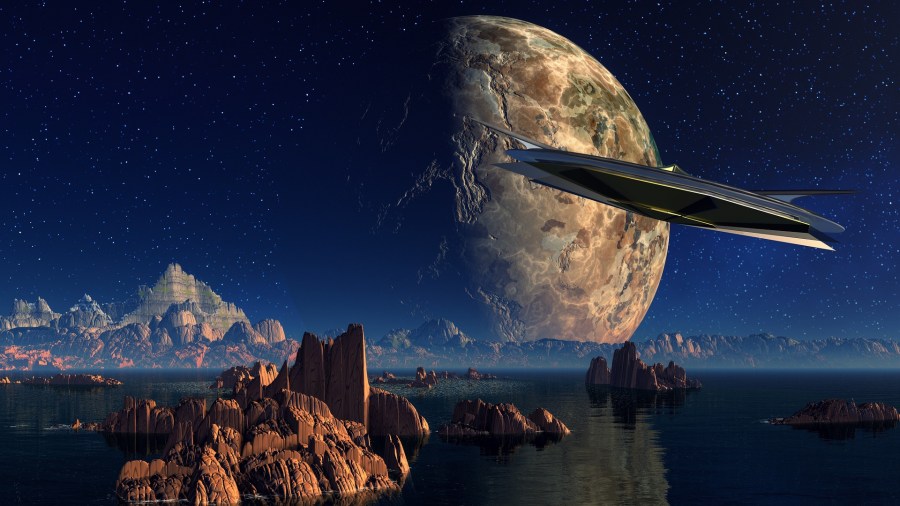
We dream of reaching the stars. Indeed, it’s at the core of what I’ve been writing, and the same is true for many other science fiction authors. It’s also the subject of intensive research by some fairly serious scientists, even if they don’t quite get the billing and notoriety of NASA projects focused right here in our own Solar System.
But is it truly possible?
I like to think so, but I also understand that the challenges are incredibly daunting, more so than the majority of interstellar-themed science fiction stories would have us believe.
Bestselling author Kim Stanley Robinson tackles the challenges of so-called generation ships, in which people will be born, live, and die during the voyage, and only the grandchildren of the original astronauts will be alive at journey’s end in his 2015 novel Aurora. It’s a great read, and I highly encourage you to check it out. I won’t spoil it for you by talking about his conclusions in the novel.
But Robinson also wrote a blog post discussing his thoughts on the various challenges faced, Our Generation Ships Will Sink, and perhaps the title gives it away. He goes into some detail about the issues faced with biological, ecological, physical, sociological, psychological… lots of logicals there. Even upon arrival, the problems don’t cease.
Robinson’s article is a great read, but if you want a nicely wrapped up synopsis of it, I recommend Richard Rabil Jr’s Stars Beyond Our Reach, linked at the beginning of this post. Rabil is a technical writer, who writes both fiction and essays on subjects as diverse as technology and faith, and he tackles many interesting subjects on his blog (which I’ve only just discovered, but so far it’s very promising). He also does a great summary of the evolution of science fiction as a genre, another post I can strongly recommend.
If, like me, you are fascinated by realism in our quest to reach the stars, Rabil’s summary is a good place to start.
header image credit: Reimund Bertrams (user:DasWortgewand) / pixabay.com under Pixabay License

Do you prefer reading first-person or third-person narratives? Does it make a difference when the story is in a particular genre? Does the narrative point of view give the story a different feel for you?
I know I don’t need to detail for you what I mean here, but just in case:
For a long time the general advice to novelists was to stick with third-person narration, and past tense only, please. First-person narration was for autobiographies and hard-boiled detective stories only, though I think you could find a number of examples in 19th- and early 20th-century literature (think H.G. Wells, for instance). However, a common narrative form of the age was to have a first-person narrator who was not in fact the main character of the story, or even very important to the story. This may seem strange to us today, but it allowed the author to slip into the role of fireside storyteller, relating events of some character he or she had met (if only in his or her imagination).
W. Somerset Maugham’s 1944 novel, The Razor’s Edge, was written in this manner: the author himself is the narrator, but is only barely tangential to the story of Larry Darrell and his friends. Writing in this manner gives the story a hint of “This is something that really happened,” while nevertheless remaining entirely fictional. On the other hand, it would seem to have the drawback of not allowing the storyteller (and thus the reader) to be present when the action occurs far away. In Maugham’s novel, Darrell travels to India and spends years searching for the meaning of life, yet we as the readers only learn of it when he returns to Europe and relates his tale to his friends — one of whom is the author/narrator. Perhaps Maugham didn’t want to emphasize the mysticism of Darrell’s eastern travels, instead keeping the focus on personal relationships more familiar to a western audience, but it was a disappointment for me to not be there when Larry sits on a mountaintop meditating.
Past advice notwithstanding, many great novels — and not just detective stories — are written in first-person. Such a style can make the action much more personal, as we are definitely inside the head of the narrator-protagonist. It can also allow for an unreliable narrator, a main character who relates events to us as they perceive them, or perhaps even as they wish to be perceived, and only later in the novel do we find out that the story’s “inner reality” is different.
But first-person narration also has its drawbacks. Classically, it restricts the author to telling the story from only a single point of view, though in modern times this “rule” has been broken quite successfully (see My Sister’s Keeper by Jodi Picoult for an example). It also classically has been taken as an indicator that the narrator survives to the end of the story, in order to be able to tell the tale, but again — spoiler alert! — see Picoult’s afore-mentioned tale.
It is possible to obtain that same “inside the protagonist’s head” feel with third-person narrative, using a technique usually called Deep Point of View (or Deep PoV). For example:
He raised the heavy gun, shakily pointing it at the assassin, who loomed large in the alley. The assassin laughed.
vs
He raised the gun — how did it get so heavy? — and pointed it at the assassin. The man was huge! To make matters worse, the assassin merely laughed at his feeble effort.
Deep PoV attempts to have the reader identify with the character as much as first-person narration does, but still retain some of the detachment of third-person.
What about second-person narration? Is there such a thing? Indeed there is! Though I’m not sure I’ve ever seen it with past tense, so:
You dash into the alleyway, gun drawn, and confront the assassin.
As a writer, you will likely be told, over and over, never to write this way, that such a book will never sell.
Jay McInerney laughed all the way to bank after his debut novel, Bright Lights, Big City went bestseller. Yep, all second-person. Same for N.K. Jemison with her Hugo-award-winning novel, The Fifth Season. For a science fiction example, see Charles Stross and Halting State, plus its sequel, Rule 34.
Second-person narration is very hard to pull off, however. If not done exceptionally well, its very strangeness can be off-putting.
Having now mentioned tense, let’s dive into that. Again, traditionally, stories have been told in past tense — He dashed into the alleyway — giving it that feel of an oral tradition, related by elders around the campfire, of mythic deeds by mythic heroes of an ancient age. But in the past few decades, present tense novels have come into vogue. Granted, such writing has existed for some time: Ulysses by James Joyce, published in 1918, employs present-tense narration. Going back even farther, Charles Dickens used present tense for his 1852 serial, The Bleak House.
Still, throughout most of the 20th century, most novels were written in past tense. Lately, however, that seems to be changing. While still true — I think, as I don’t have a statistic on this handy — that while most novels today are in past tense, clearly an increasing number of them are coming out in present tense. This certainly seems prevalent with YA novels — The Hunger Games (Suzanne Collins), Divergent (Veronica Roth) — but is definitely not restricted to that genre. The second-person novels I mentioned earlier, for instance, are also present-tense novels. The Girl on the Train (Paula Hawkins), The 5th Wave (Rick Yancey), and, yes, infamously, Fifty Shades of Grey (E.L. James), are also present-tense novels. The list is quite long, really.
You will probably notice that many of these are also first-person narration. Certainly this isn’t universally true, but it feels more natural — to me, anyway — to couple present tense with first-person.
What about future tense?
I admit, I’m not aware of any examples of novels written in future tense, and I have a hard time imagining flowing prose in such a style, at least in English.
He will dash into the alleyway, gun drawn…
Sounds more like a prophecy than a story.
Of course, we could go crazy with future perfect (He will have dashed…), future perfect progressive (He will have been dashing…), and so on, but you can see how cumbersome this quickly gets. Perfect, progressive, and perfect progressive modifiers can be applied to past and present tense as well, of course, but in all cases this starts to add a lot of words to describe an action.
So that was a long ramble, but why do I bring this up? If you’ve been following my work-in-progress, The Silence of Ancient Light, you’ll note that I’ve been writing (oh, there’s past perfect progressive!) in third-person past tense. However, you’ll also note that there is, so far, only one point-of-view character, Anna Laukkonnen. I think in the early scenes I managed to achieve some deep PoV with Anna, but as I look back on the later scenes, I sense that I’ve drifted a bit from this, which is something I’ll need to correct in the next draft.
But, if the story is entirely from Anna’s point of view, would it make more sense to change it to first-person narrative? I admit, I’m currently undecided on this point. I have written other stories in first-person, and I’ve generally found it to be a comfortable style for me. I am striving for that deep personal perspective, and for me that’s perhaps a little easier in first-person, but it doesn’t have to be that way.
As a reader, I enjoy books in both first- and third-person — and yes, I enjoyed The Fifth Season in second-person as well, though with Halting State I admit it took me a while to get used to it. So, I don’t have a strong preference one way or the other, but instead want to use the style that best lends itself to the tale I have to tell.
The vast majority of my writing has been traditional past tense, as well, but recently I’ve tried my hand at some present-tense writing, and I’ve found it can set a certain mood to a story that is sometimes appropriate, though not always. I’m not against it, though I’m not sure it’s what I want for Silence.
What do you think? What is your preference? What do you think would work best for Anna and Silence? If you’re a writer, what feels most natural to you?
header image credit: Stefan Keller (user:kellepics / pixabay.com) under Pixabay License

(The Silence of Ancient Light, continued)
The howl of the storm echoed through the tube, a banshee screaming in furious reverberation, increasing in ferocity and beginning to drive sideways rain many meters in from the cliff entrance. Any thoughts of waiting it out near the entrance now gone from their minds, Anna and Laxmi scrambled toward the inner end and peered into the dark void beyond, their headlamps piercing the gloom with twin beams of focused light.
The roughly eight-meter long by one-meter wide tube ended much as it began, with a sudden and smooth circular opening in the midst of an inward-facing cliff. Beyond lay a dark, cavernous chamber, its size lost in the black, though Anna’s headlamp picked out crystalline reflections sparkling from what might be the far side, a few hundred meters away. The floor of the chamber lay not far below them, a half-dozen meters, with a deeper narrow gully between the main floor and the wall from which she peered.
Read more at…
Yes, I know I told you that I was going to resume work on an older work-in-progress, for the moment called Shadow, but I also said I’ll still continue with Silence, didn’t I? So continue I have done, and will do, and here you go, the latest installment. Anna and Laxmi escape from the hurricane, burrowing deeper into the cave they’ve found, but what awaits them inside? What secrets of the mysterious missing Keplerians might be revealed?
You’ll have to read the scene to find out! And as always, I welcome feedback of any kind.
Until the next scene…
header image credit: user:darkmoon1968 / pixabay.com under Pixabay License
Books, games, music, and life — filtered through the mind of a writer, drummer, and philosopher who thinks too deeply about all of it. If it moves something in your chest, I'm interested.
Read. Play. Watch. Listen .
Leadership Coaching for Managers and Emerging Leaders
Almost Meaningful
Observations and opinions of a crime-fiction crazy bibliophile and addicted cruciverbalist.
Where brevity meets depth, and verse sparks change.
Celestial Visions for Boundless Worlds
The Musings of a Writer / Editor in Training
Spit mixed with dirt - Muddy words flow
PUBLISH STORIES.

