Drafting For Two

A little over a year ago, I spent the Christmas holiday with my wife Carole in Bend, Oregon, to ski the famous cross-country tracks of Mt Bachelor and environs, taste the famous microbrews of the Bend Ale Trail, and lay down some serious drafts, writing retreat style, for my novel.

Bend had a notoriously low snow year, so we accomplished only a little skiing. We did, however, collect some growlers from a handful of wonderful brewpubs.

Growlers
© Matt Fraser, 2019

And I spent hours staring at my laptop, completely blocked.

It wasn’t a problem of the words not flowing, though I’ve faced that at times, too. I simply couldn’t figure out the plot. I had an idea, summed up in a couple of sentences, but could not figure out the sequence of events that would tell the story. I had devised a few character sketches, I knew roughly who my protagonist was, knew a bit more about my antagonist, and had a wonderful concept for a contagonist impact character. I even had the broad strokes of how to bring the first act to a close, and what sort of crisis would precipitate the third act climax, though the details remained fuzzy.

I just had no idea for what should happen in between.

Carole had a perfect description for my state: analysis paralysis. I was so focused on getting every plot point just right that I was letting perfect become the enemy of the good. I sipped drafts from the collected brews of the Deschutes valley, but found no further inspiration there. And then Carole said something fateful.

“Why don’t you stop worrying about the plot and just write? It worked for you in NanoWrimo, so why not now?”

2013-Winner-Facebook-Cover
Yes, I “won” in 2013

So I did just that, albeit not with this project. I set my unfinished plot outline aside, and simply began writing, without any plot worked out in advance, based upon a simple image I held in my mind, an image of alien ruins, signs of an advanced civilization, long abandoned. I saw space stations, falling apart in orbit around a darkened planet, and the arrival of human explorers to investigate.

The result of that stream of consciousness experiment is still unfolding, as The Silence of Ancient Light, and some of you have been reading along as I post my first draft scenes on these pages. That was another part of the experiment, to post scenes as I went, thus “forcing” myself to keep going.

I’ve made mistakes along the way. I’ve posted scenes, only to realize one or two scenes later that I got a technical detail wrong, some point of astrophysics or orbital mechanics that just wouldn’t work. I’ve thought of better ways to handle events for already posted scenes, and then struggled with whether to keep writing in a manner consistent with what’s already been posted, or to write as if the earlier scenes had been different. Of course, that would make the narrative confusing for anyone trying to read through, but it is a first draft, after all.

Perhaps worst of all, however, is that I’ve concluded I had my characters go down a path I didn’t want them to tread several scenes earlier, and I’ve written myself into a corner. Now what do I do? Do I keep writing the story as it has been unfolding, even though it isn’t really where I wanted it to go? Do I go back for a “do-over” and rewrite everything from that point forward? And if so, do I create a new fork in the thread of the story, leaving the originals as they are as signposts for my folly?

Some of you may have noticed that I’ve slowed down on my output for the draft, and this crisis of my own making is the major reason.

Along the way, I’ve had concepts and ideas for other novels come to mind, as they do, and even been tempted when the writing on Silence slowed down to break off and explore one of them. The writing community over on Twitter (great group!) was practically unanimous in their advice not to do that, to make notes on the concept, but keep going on the current draft, finish what I’ve started. And so I’ve been doing just that.

Yet a new conundrum has arisen.

Remember the original story idea, the one I was trying and failing to carefully plot during that winter retreat to the land of ales and trails a year ago? The one I put aside to work on Silence instead?

I think I’ve solved my plot blockage.

There is still a lot of work to do before I begin drafting the prose, but I have a very high-level outline for 60 scenes spread across 20 chapters (those numbers may and probably will change). With a few more days (or weeks, more likely) of work, I should have an outline detailed enough to be called a treatment, a plan for simply “writing down the bones,” scene by scene, chapter by chapter.

And this, after all, was my original project, which I set aside to work on Silence. So, should I now set aside Silence to return to it?

No, I don’t think so, and I don’t think you think so, either.

So how successful can I be, working on two projects at the same time? That depends. Silence was always intended to be a way to break the logjam, to spur creativity and to keep writing, to keep up the practice. If, along the way, it turned into something decent, that would be a bonus. I do think there’s something decent in there, even if it’s gone a little bit off the rails, so I’m nowhere near wanting to abandon it. It deserves better than that.

At the same time, I’m ready to breathe new life into my more “serious” project. (It has a working title, but I’m holding that in reserve for the moment; for now, we’ll call it Shadow.) Yet there is a difference in the stages of creation for Shadow vs Silence. I’m plotting Shadow, whereas I’m drafting Silence. Shadow has a careful structure to it; Silence is by design more free-form.

I can see myself going back and forth between the two. When I’m stuck with something in Shadow, I’ll return to stream of consciousness writing with Silence. When I write myself into another corner in Silence, I’ll wrap up the next subplot in Shadow.

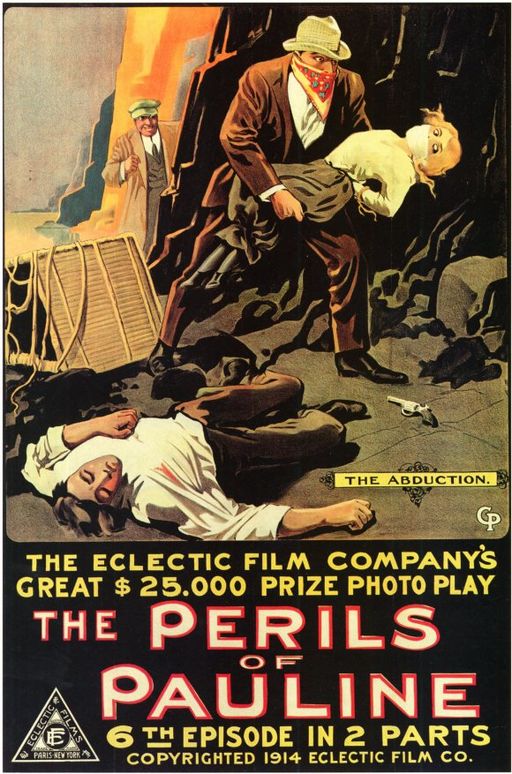
I’m undecided whether I will post scene drafts from Shadow in the same way that I have for Silence. One negative side-effect of doing so has been finding myself writing for the effect of the next post, instead of writing for the effect of the narrative whole, thus giving the unfolding story a bit of a Perils of Pauline serial feel to it. When the work is complete, I don’t want the reader to feel as if she is reading a series of shorts; I want her to enjoy it holistically, to be unable to put it down until reaching the very end.

Nevertheless, I may still do so, but I make no promises. Meanwhile, though, you can still expect to see scenes from Silence appear in these pages.

Some of you likely have strong thoughts about this approach. Feel free to critique me in the comments! Seriously, I want to hear from you.

Until the next cliffhanger…
512px-Perilsofpauline
used under Public Domain

header image credit: user:JAKO5D / pixabay.com under Pixabay License

Social Sharing and Google+

It’s an admission of defeat, I suppose. Even the giants know when to cut their losses, let someone else own the field, and move on to other arenas where they can be successful.

No, I am not talking about myself, although this does impact me in a minor way. It impacts some few of you, too, perhaps, though it would seem to be very few of you, which is why this is happening.

On April 2nd, Google is shutting down their competitor to Facebook, Twitter, and the like, aka Google+. You may have noticed — you may still notice for now — the little G+ icon at the bottom of most posts and pages on this site, either under “Share this” or “Let’s get social.” Depending which one you press, it either made it easier to share my content on your own Google+ page, or to link directly to mine. That icon sat next to similar ones for Facebook, Twitter, and Tumblr, which are not going away anytime soon (well, I’m undecided about Tumblr; more on that in a moment).

To date, anytime I’ve posted something here, I have (either automatically or manually) linked to it on these four platforms, on each of which I have a related page or feed. I have modestly lively interactions on Twitter, fairly quiet but occasional interactions on Facebook, practically none on Google+, and absolutely zero on Tumblr.

Apparently Google has decided that they, too, have very little going on with their social media platform, and thus their decision. The layout of the platform was actually rather nice; it just never seemed to gain any traction.

So, the disappearance of my Google+ page, and those links from this site, will pass with nearly no one noticing.

I’m tempted to stop publishing to Tumblr as well, as that medium appears to not be very well suited to text; I think it’s more about sharing photos and visual artwork. What do you think?

Should I replace these social sharing platforms with others? Pinterest, perhaps, or LinkedIn? Where do you find it easiest to consume content, or to receive notifications of new publications? Where would you most like to share such content, assuming you’re so inclined?

Let me know what you think!


header image credit: user:Photo-MIX Company / pixabay.com under Pixabay License

The Approaching Storm (WIP)

With a satisfied exhalation of breath, Laxmi sat beside Anna in the tube’s mouth, her sling of rock tools collected during her climb dumped in a jangling heap behind her, and followed Anna’s gaze out to sea. A hazy mist completely obscured the horizon, sea and sky blended together with no division, but rather a gradient from light grey descending into darkness where the horizon should have been. The distant, tall clouds they noticed earlier had now coalesced into a mass of towering giants, crenellated turrets at their peaks reaching for the heavens, and merging at their base to a solid dark wall. Nearer to hand the sun still sparkled off the sea, all the brighter for the contrasting darkness beyond. A breeze lifted a lock of Laxmi’s hair, and she turned to Anna, frowning.

“Should we be worried about that?”

… Read more at… Stormfront


header image credit: pxhere.com under CC0 public domain

Intrepidly Exploring Inland (WIP)

While I’ve been exploring the jungles of Peru, the stranded astronauts of Aniara have been exploring the jungles and islands of Kepler 62f, fifth planet of a star 1200 light-years distant from Earth. I know you’ve been worried about the fates of Anna, Laxmi, and Jaci, so read on to learn what happens as they press…


Inland


It has been a few months since I last published a scene from my serial work-in-progress, The Silence of Ancient Light, so if you’re just joining us on this journey, you might want to start at the beginning. You can find an overview of the chapters and scenes so far at The Silence of Ancient Light.

Speaking of publishing scenes, I have a question for you. Do you find it more effective — are you more drawn in to want to read — if the scene is published as a page, the way I’ve been doing so far, accessible via menu links and so forth, and then announced with blog posts like this one? Or would you rather see the text of the scenes appear directly as blog posts?

There are pros and cons to each approach. Blog posts appear automatically in the WordPress Reader, for instance, and thus if you have a WordPress.com account, it’s possible for you to read the entire scene from your Reader feed without ever having to visit my website. Static pages do not, so you have to click the link in this post to take you there. I notice that I get more visits and likes on blog posts announcing scenes than I do on the scenes themselves, which leads me to believe that many people never follow that link. Pages also do not have a mechanism for assigning categories and tags, so there is less control over search terms and keywords. They may or may not show up as easily in Google searches.

On the other hand, blog posts become ‘lost’ in the blog roll over time, without an easy way to link directly to them with website menus. They can be found via category links, of course, but it would be more difficult for someone who wanted to read all the scenes straight through, in order (do any of you do that?). So, I tend to think of the blog as having a more immediate but short-term advantage, and the page as being more persistent and easier to find in the long-term, at least for someone who knows what they’re looking for.

What do you think?

What about a hybrid approach, posting the scene first in the blog, and then copying it later to a static page? Or would the repetition be a turn-off?


header image credit: user:DasWortgewand / pixabay.com under CC0 1.0

Changes in Latitude

4°.

Well, 3.7° to be more precise. No, not the temperature (not by an order of magnitude!). The latitude. 259 miles south of the equator. 340′ above sea level.

Hot. Humid. Muggy.

There are no direct flights from North America into Iquitos, so first one makes one’s way to Lima, the capitol of Peru. Even that is not a straight shot from Seattle, so instead I flew to Chicago, which felt sort of like going the wrong way, and from there to Toronto, which really felt like going the wrong way, where I met up with Dale in the airport before catching the long leg down the east coast, across the Caribbean, and into South American airspace. We arrived in Lima in the middle of the night and made our way to the airport hotel, where I had my first taste of the classic Peruvian pisco sour.

I could grow to really like this drink, I thought.

In the bar of the hotel we met up with Kate and Steve, Canadians who would be paddling in the race, and subjects of Dale’s documentary. With their arrival, I had a second taste, and the four of us kept the barman busy until it was time for the Canadians to catch their flight to Iquitos. I think they found this preferable to trying to nap on the floor of the airport.

Wait, what race? What documentary? And what are we doing in Peru, again? Hmm, rather than explain it all over, go back one blog post for the introduction to this story and how I found myself, on practically no notice, dropping everything to jet off to the jungle.

Meanwhile, Dale and I stayed in Lima an extra few hours. I was scheduled to appear as a speaker on a professional webcast that morning, and the hotel WiFi in Lima was going to be far more reliable than anything we’d likely find in Iquitos. That proved true, the webcast went well (“Greetings from Peru!”), and as soon as it was over we rushed back into the airport for our own flight.

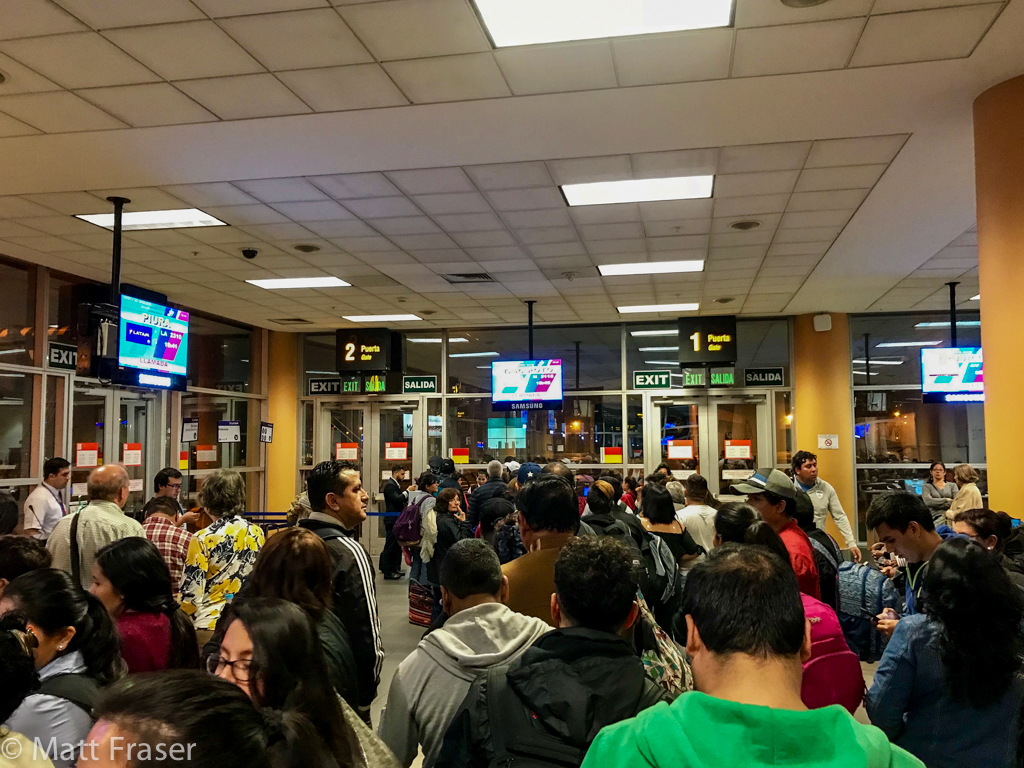
Where we waited. And waited. Then we waited some more, as our flight was delayed, then delayed some more. To make things worse, the stated destination over the gate kept changing. Sometimes it said Iquitos. Then it would say Tarapoto. We were pretty sure the plane was going to both cities, we just weren’t sure in which order.

Domestic Gate at Lima Airport

“¿Es este el vuelo a Iquitos?” asked an older gentleman of us as we stood in line to board. Is this the flight to Iquitos? Even the locals were confused!

“Sí… Yo creo que,” replied Dale. Yes… I think. Ah well, they accepted our boarding passes, so surely it was the right plane.

By this time it was already evening, and as Tarapoto lies between Lima and Iquitos, we assumed we’d be landing there first. It was pitch black outside, so no landmarks could be seen to assure us. To my regret, I never was able to catch sight of the famous Andean Cordillera when we passed over. It was only as we started to descend, and we began to see rivers and tributaries reflecting the starlight, that we knew we were well and truly over the Amazon basin. We began to see the lights of river barges as we flew lower and lower, and then we touched down on a short runway between the bright city and the dark jungle.

Heat. Humidity. Flying insects. Unenclosed airport (though not as glamorous as Kona, perhaps). I could grow to enjoy this place.

Bags collected (pelican case, photography gear), the haggle for a moto-taxi ride into town began.

“¿Diez soles?”

“No, no, veinte.”

“¿Quince?”

“Veinte.”

We moved on. 20 soles (about US$6) was too much for the ride, though we knew we were unlikely to get it down to 10. The second driver we spoke to said ok to 15, and off we went for a night ride through the streets of the city.

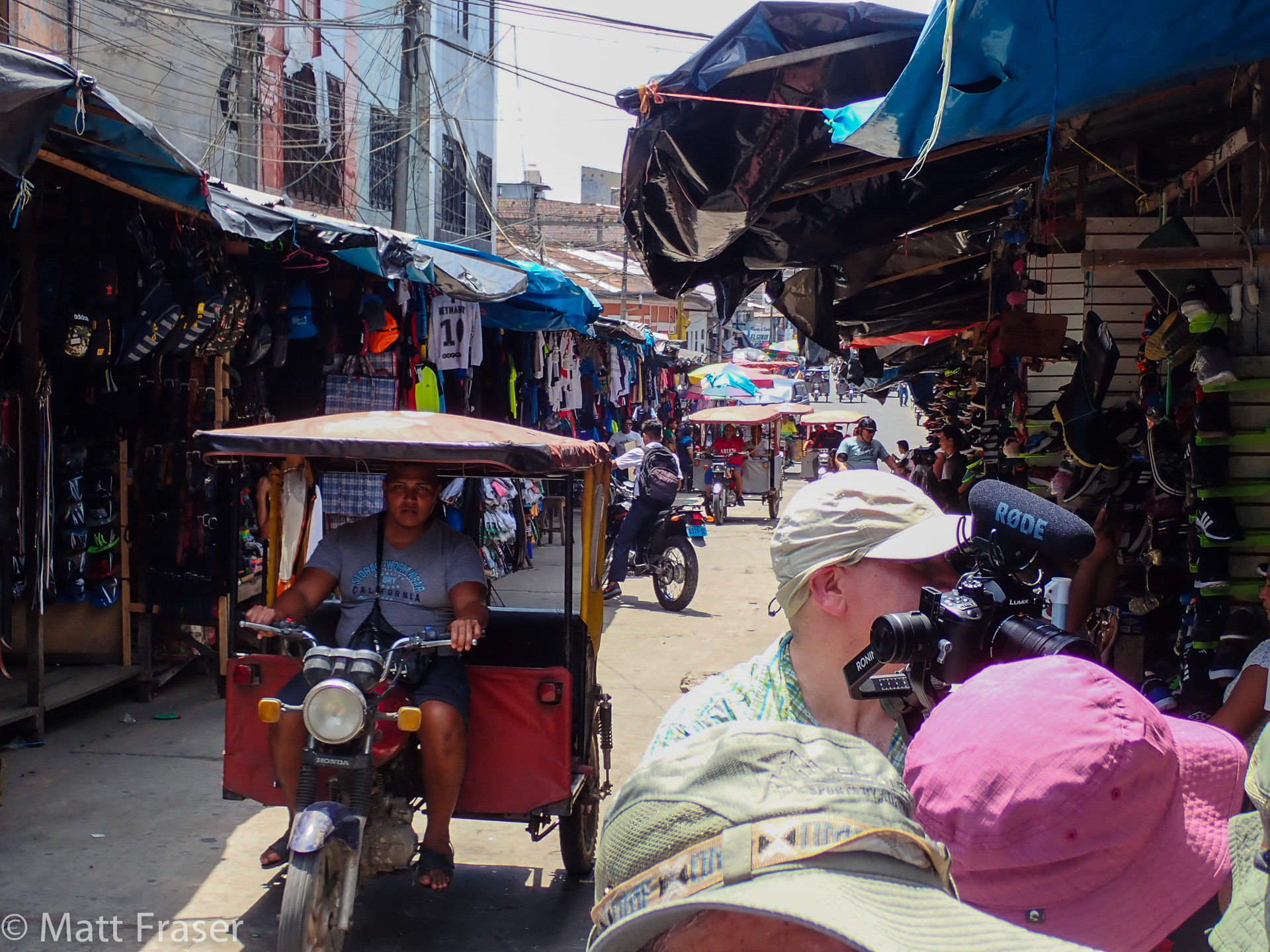
The streets of Iquitos are busy, crowded, with everyone seeming to go wherever they felt was best for them, and as such they are difficult to navigate in a regular car (though people do). So, they are crowded with motos, or moto-taxis, the same as tuk-tuks found in southeast Asia. Essentially these are the front half of a motorcycle and the back half of a rickshaw, able to carry three passengers in addition to the driver, and they dominate the city. Almost all of them are for hire, operating on a cash basis, so it is essential to carry plenty of coins in order to have correct change. Residents and visitors alike get around by moto-taxi, and as long as you negotiate your fare before getting in, the drivers will honor it without hassle when you arrive at your destination. Indeed, a good moto driver can make or break your search for just the right place in Iquitos when you need a certain part for the construction of a raft, but we’ll come to that later.

Belen Market, Iquitos, Peru

Motos are not clean machines, contributing greatly to the smoke filling the streets, nor are they quiet. From about 6am until Midnight, the sound of moto engines can be heard all over the city. On a hot night, however, riding in the back of one can be just the thing, a breeze in your face and hair, to make you feel that little bit less sticky.

It’s about a half-hour ride from the airport into the heart of the city, to our lodgings at the Green Track Hostel. We arrived to a dark street, and a barred and gated doorway. We rang the bell.

Moments later, the door opened, light flooded out, and there stood Kate! We were in the right place.

“Where’ve you guys been? We were expecting you hours ago!”

“Long story. Flight delays, changing destinations…”

“This is Peru,” she said, and off we went to find dinner at the Plaza de Armas, a picturesque, green, and lush city square ringed with shops and restaurants and, yes, motos.

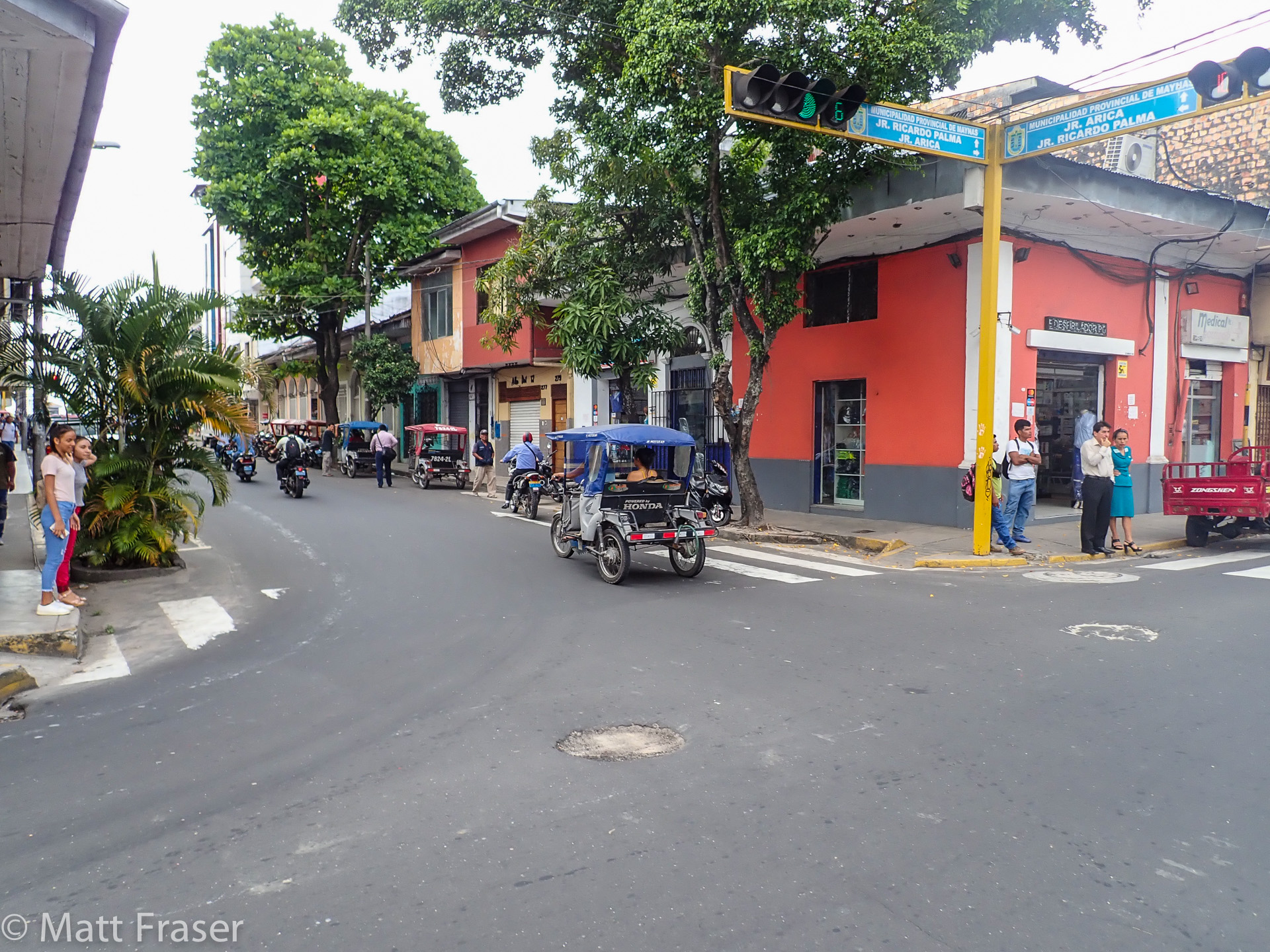
Iquitos Street Corner

I could grow to like this place.