Iquitos and the Amazon

If you’ve been wondering where I’ve been, I’ve been having adventures!

A few months ago I found myself in rather urgent need of a high-resolution portrait photo. How urgent? Well, a professional organization related to my day job wanted to give me an award, and they wanted to show my face on a huge banner at their annual conferences, in three cities on three continents, no less, and the first conference would be in a matter of a few weeks. Could I send along something of at least 300×300 dpi resolution, 30″ square, and by the way, tomorrow would be good?

If you do the math, you’ll quickly realize they were looking for a serious professional shot, not something I could whip out on my iPhone. I needed to bring in the big guns, and fast.

I gave my good friend Dale a call… well, ok, a text, really… and, what luck! He was actually in town and available. Dale is a semi-pro photographer, a reviewer and editor at one of the most prestigious online photography review magazines, and a freelance documentary filmmaker on the side.

“Sure,” texted Dale, “I can do that for you. But, I have a favor to ask. Do you remember that log raft race I won twelve years ago on the Amazon River? I’m going back to make a documentary about the race, and my usual assistant just canceled on me. It’s really a two-person job, so you’d seriously be helping me out if you could come with me to Peru.”

history ancient peru south america
Photo by Amanda Kerr on Pexels.com

Peru? Cool! I thought, imagining this would be months in the planning. “That sounds like a great trip. When are you planning to go?”

“In a week.”

Pause.

“A week?” I’m pretty sure disbelief would have colored my voice, if this whole conversation were not happening by text message.

“Yep. I know it’s last-minute, but I’ve already invested a lot into this trip, and losing my assistant has put me in a bind.”

One thing you should probably know about Dale is that we met as students in a climbing course. We had scaled peaks together. We had camped overnight in an emergency snow trench together. We had literally held each other’s lives in the balance on belay during rock climbs. I knew that Dale had spent a couple years backpacking around South America, and that he was fluent in Spanish. I knew he had spent three days paddling a log raft on the Amazon while he was there. So I knew that he knew what we’d be getting into with this trip.

Mt Rainier Emmons Route
© Matt Fraser

What’s more, Dale knew that I had wintered in Antarctica back in the day. He knew that I  had trekked the Himalaya and navigated the alleyways of Kathmandu. So he knew that I’d likely be fine for a little escapade in the Amazon jungle, and that the streets of a tropical Peruvian city were unlikely to faze me. He wasn’t asking an unknown to cover his back on this adventure.

Streets of Thamel, Kathmandu, Nepal
© Matt Fraser

“Give me ten minutes,” I replied. “I need to talk to my wife. And my boss.”

Fortunately for me, both my wife and my boss are adventure-minded in their own ways. Despite the short notice, the only issue my boss raised was that he’d prefer to be the one to go. Sorry, boss; this one was mine.

Ten minutes later I committed to travel to Peru in a week’s time, and then I called my doctor’s travel clinic to arrange for vaccinations.

Fortunately, much of what I needed in the way of vaccinations I already had from my time in Nepal, although a few had expired and required renewal (typhoid, tetanus, etc). I would need anti-malarial pills. And… ah, I would need a yellow fever shot. That was new.

The administrator for the travel clinic told me that it would be a week and a half before I could get on the schedule to see the travel nurse.

“I don’t have a week and a half,” I said. “I’m going to Peru in one week.”

“Oh. Where in Peru?”

“Iquitos.”

Ten minutes later the travel nurse called me back directly.

“You’re going to the Amazon!”

“That’s right.”

“You need a yellow fever shot.”

“I know.”

“Almost no one has it in stock right now. It’s in short supply all over the country. We’re ordering in an alternative from France, but it’ll take me ten days to get it here.”

My heart started to sink. I weighed the idea of just going without, but there are some complications with this particular nasty little bug. It’s rare to catch it, but if you do, there’s a scarily high fatality rate, and by all accounts it’s not a pleasant way to go (not that many ways are all that pleasant). And, because of its lethality, many countries require visitors to show documentary proof of having had the shot, depending on where they arrive from. Coming from the US, it seemed unlikely that Peru would require me to show the classic yellow vaccination card, but it seemed entirely possible the US would ask to see it upon my return.

And if not the US, well, a week after getting back I would be jetting off to Spain. Remember, the professional conference for which I needed the headshot photo that started all this? Yeah, that would be in Barcelona, and I was going. I had no idea whether Spanish authorities might see that Peruvian stamp in my passport and then say, “Tarjeta amarilla, señor?” It would be a shame to be turned away from the conference at which I would be winning this award.

“It’s ok, though. There’s a pharmacy in Sand Point that has yellow fever vaccine in stock, and they take walk-ins. Call this number.”

All was not lost! Hastily I wrote down the number, thanked the nurse profusely, and then gave it a call. I was able to make an appointment for the next day, and there I was able to stock up on everything the savvy traveler might require: anti-malarials, antibiotics, anti-diarrheals… pretty much anti-everything. And a course of typhoid pills, a tetanus booster, a flu shot while I was at it, and the all-important yellow fever shot, the most expensive vaccine of the bunch.

One week later I boarded a plane with no luggage besides a backpack, everything I would need for two weeks of equatorial living. I left the sweater at home.

Oh, and Dale snapped a great portrait.
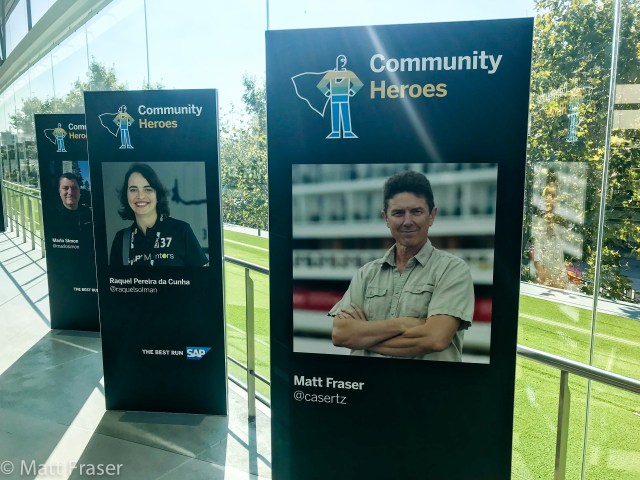
SAP TechEd Barcelona 2018
© Matt Fraser, enclosed portrait © Dale Baskin

Stay tuned for the next part of my Amazon adventure.

In the Year of ’39

In the year of ’39 assembled here the volunteers,
In the days when lands were few;
Here the ship sailed out into the blue and sunny morn,
The sweetest sight ever seen.

Lately I’ve had this song running through my head, pretty much on constant repeat. It’s an old song, first released in 1975 on the album A Night at the Opera by Queen.

And the night followed day,
And the storytellers say
That the score brave souls inside
For many a lonely day sailed across the milky seas,
Ne’er looked back, never feared, never cried.

At first it seems to be telling a relatively ordinary story. Volunteers set sail in a ship for a dangerous journey. Is it 1939? Is this something to do with World War II? It’s not really clear yet.

Don’t you hear my call though you’re many years away,
Don’t you hear me calling you;
Write your letters in the sand
For the day I take your hand
In the land that our grandchildren knew.

Wait, what? The land that our grandchildren knew? Ok, there is something odd going on here. And what’s this about being many years away? The song seems to be playing around with time.

In the year of ’39 came a ship in from the blue,
The volunteers came home that day,
And they bring good news of a world so newly born,
Though their hearts so heavily weigh;

For the Earth is old and grey,
Little darling went away,
But my love this cannot be,
For so many years have gone though I’m older but a year,
Your mother’s eyes, from your eyes, cry to me.

Right, this is definitely not an ordinary ship sailing ordinary seas, and time is certainly being twisted. The volunteers bring news of a new world, while the Earth is old and grey? We’re talking about space travel, aren’t we? In fact, we’re talking about interstellar travel.

It’s definitely not 1939.

Many music lovers might have been confused by this song, but by now it should be obvious to readers of this blog what’s going on here. For astronauts to travel far enough to discover another world (“so newly born”), one capable of replacing the “old and grey” Earth as humanity’s home, and return back with the news “older but a year,” they must have traveled very fast indeed. Perhaps even approaching the speed of light?

At speeds this fast, the theory of special relativity tells us (and experimental research has shown) that odd things happen with time. Time appears to slow down for the traveler, at least relative to the stationary observer, so that by journey’s end the traveler will have aged far less than those who stayed home.

In the year of ’39 assembled here the volunteers

2139, perhaps? 2239? It’s not completely clear.

In the year of ’39 came a ship in from the blue,
The volunteers came home that day

Not the same ’39, but 100 years later. 2239? 2339?

For so many years have gone though I’m older but a year

As it happens, given the parameters of the song, we can calculate how fast the ship was traveling, and thus how far away they went, and perhaps even speculate what star they visited! This is because, despite being such a non-intuitive phenomenon, time dilation due to relativistic effects is well understood, and there is an equation to calculate it.

t'=t\sqrt{1-\frac{v^2}{c^2}}

Where:

t’ = dilated time
t = stationary time
v = velocity
c = speed of light

We want to know the ship’s velocity, so let’s parse this out (like traveling back in time to algebra class!):

t'^2=t^2\times({1-\frac{v^2}{c^2}})

\frac{t'^2}{t^2}=1-\frac{v^2}{c^2}

\frac{t'^2}{t^2}+\frac{v^2}{c^2}=1

\frac{v^2}{c^2}=1-\frac{t'^2}{t^2}

v^2=(1-\frac{t'^2}{t^2})\times c^2

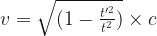
v=\sqrt{(1-\frac{t'^2}{t^2})}\times c

Ok, let’s plug in some numbers! To keep things simple, we’ll express velocity as a percentage of the speed of light, and time in years, even though normally in physics equations velocities would be meters per second and time in seconds. But at this scale, those would be some big numbers, so we’re going to assume that c=1, and that v therefore is a percent of c.

v=\sqrt{(1-\frac{1^2}{100^2})}\times 1

v=\sqrt{1-\frac{1}{10000}}

v=\sqrt{1-0.0001}

v=\sqrt{0.9999}

v=0.99995

In order for 100 years to have passed on Earth while only 1 year passed for the astronauts, the ship had to be traveling approximately 99.995% of the speed of light. That is some extreme time dilation, and so that is some extreme speed. Quite the starship!

Time isn’t the only thing dilating here, as traveling at these speeds does some interesting things to the fabric of space as well. Distances ahead of the travelers will appear to shrink somewhat, though even at this high fraction of the speed of light, it’s a minimal effect. Add a few more 9s to the significant digits, however, and it gets very strange indeed.

Meanwhile, though, our travelers have spent a year journeying at very close to the speed of light. How far have they gone? One light-year?

Oh no. They’ve gone much farther than that. The distance traveled is at a speed relative to time for the stationary observers waiting patiently back on Earth, so our starship has traveled a hundred light-years, though it seems to the astronauts to take only one year to do so.

So, what star might they have visited to find a “world so newly born” to which humanity could relocate? First off, this was a round-trip, so with half the time spent journeying out and half spent returning, that would imply they went no more than fifty light-years away (“no more than,” I say, as if this is no big deal, but fifty light-years is a very big deal). Gliese 163 is 49 light-years away and has one potentially habitable world, but it’s not considered an absolutely prime candidate.

Let’s assume, for a moment, that our starship took a little bit of time to accelerate and then decelerate on its journey, so that instead of 50 light-years, perhaps it really only traveled about 40 light-years away.

They went to Trappist-1.

Artist’s impressions of the TRAPPIST-1 planetary system
image credit: ESO/M. Kornmesser (https://www.eso.org/public/images/eso1805a/) under CC-BY 4.0 (https://creativecommons.org/licenses/by/4.0/)

Trappist-1 is a cool red dwarf star 39.6 light-years away, and it has seven temperate and terrestrial planets, four of which are considered potentially habitable even by conservative estimates. Trappist-1 is obviously a prime candidate for finding life, or at least worlds on which humans could live, and being at about the right distance, is also a prime candidate for our volunteers on their desperate and lonely journey.

Not that this provided much consolation to our narrator, who returns to Earth to find his wife long dead, and only a memory of her in the eyes of his (presumably centenarian) daughter (or granddaughter?).

Your mother’s eyes, from your eyes, cry to me.

’39 was written by Brian May, lead guitarist for Queen, in 1975. May, as some of you may know, is also an accomplished astrophysicist, and while the planets of Trappist-1 had not yet been discovered in 1975, he certainly understood the effects and impacts of time dilation on travel at relativistic speeds. May studied physics and mathematics up through the time when his music career began to skyrocket to success, though due to focusing on music after that point, it took him 37 years to complete his doctoral thesis (A Survey of Radial Velocities in the Zodiacal Dust Cloud), finally earning his PhD in 2008. He was Chancellor of Liverpool John Moores University from then until 2013, and he was a science team collaborator for the NASA New Horizons mission to Pluto.

Not just a fantastic guitarist and songwriter, but a serious scientist!

Don’t you hear my call though you’re many years away,
Don’t you hear me calling you;
All your letters in the sand cannot heal me like your hand,
For my life
Still ahead
Pity me.

’39 (Youtube)

Final note: Although Freddie Mercury is far more well-known as lead vocalist, it was Brian May who sang the lyrics for the studio version of ’39 (though Mercury sang for most of their live performances).


’39 from the album A Night at the Opera by Queen, 1975
Songwriter Brian May, copyright EMI Music Publishing, Sony/ATV Music Publishing LLC

Special thanks to E=mc2 Explained for breaking down the physics of time dilation for us laypeople.

Header image credit: user:Les Chatfield / flickr.com under CC-BY 2.0

Writing Retreats, Poll Results, and the WIP

First off, the next scene from Chapter 3 is ready for your enjoyment (and your feedback — you’re an alpha reader, remember?). Anna, Laxmi, and Jaci are making the most of their enforced encampment upon an alien tropical beach. Jaci, hindered by a broken leg and thus unable to help with much else, becomes camp cook, and quickly nominates himself “greatest chef on the planet,” based upon a competition involving “every human within a thousand light-years.” Of course, there are only three humans within a thousand light-years…

So, if you’re ready to jump right in:


Chef


Meanwhile, in other news, the poll for best scene for an audience reading is still open (see the blog post immediately preceding this one), but results are starting to narrow down to a single choice, with one runner-up. I suppose I should not be surprised that, while one scene is more action-oriented than the other, both involve significant and colorful description of the world around our intrepid explorers, and that seems to be what people are gravitating towards. But, if you haven’t yet, go vote! And then check out the results.

Meanwhile, note to self: use more (or continue using) significant and colorful description of the world around our intrepid explorers!

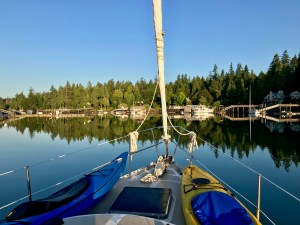
Abeona in Port Madison
photo by Matt Fraser

Speaking of colorful, I spent the weekend on another mini “retreat,” once again anchored in the middle of Port Madison Bay by myself, for the purpose of some focused writing time. While I didn’t achieve as many total words as I might have hoped, I did produce this latest scene (why haven’t you read it yet?), and had a little fun with dialogue. Do let me know what you think of it, what works and what doesn’t.

Port Madison Morning
photo by Matt Fraser

I’ll be doing more of these!


header image credit: user:ChadoNihi / pixabay.com under CC0 1.0

Audience Reading: Poll

I need your help.

A friend of mine has asked me to give a reading from my work at a function he’s organizing — ok, it’s his birthday party, and he’s a musician, and he plans to have a number of artists perform or present their art. There will be music, there will be poetry… and there will be me, reading a short bit of my science fiction to the audience.

I’ve never given any sort of public reading before, and I admit to a certain amount of nervousness. So, having read what online advice I could glean about such things — thank you, Internet! — it seems that I should try to keep it to about 5 minutes. At a typical audiobook pace of ~150 words per minute, that equates to 800 words. I’m prepared to round up, so I’m looking for a selection from my work-in-progress of roughly a thousand words.

But which thousand words? Obviously, I want it to be strong and captivating, so what does that mean when delivered via spoken word? Too much dialogue, and the audience could get lost in “he said, she said.” Too much description and too little action, and they could fall asleep. How to find the right balance?

Should it come from closer to the beginning of the work, when there is less knowledge assumed on the part of the audience? Or is a later selection ok, and just let unexplained things go?

So here are the five options I’m considering. Which would you pick? (Poll at the end of the list, or feel free to comment!)

  1. Ch.1, Approach
    1. This is the scene where Anna and Laxmi argue about aliens in the exercise room. There are some references in the dialogue to the sociological impacts of advancements in interstellar travel.
    2. 1,146 words
  2. Ch.1, Observatory
    1. Not the whole scene, but from “The observatory was a small transparent blister…” to “we outran our own historical radio waves to get here.”
    2. Here Anna enjoys some rare solitude while looking out at the galaxy and pondering radio signals; she gets a bit philosophical, and there are some nice references to the vastness of interstellar space and speed-of-light travel.
    3. 1,090 words
  3. Ch.2, Reaction
    1. This is a hard-core action scene. The shuttle is disabled and in danger of crashing, and (spoiler alert!) Takashi dies.
    2. 1,331 words; perhaps a bit long, but it’s a fast-paced scene.
  4. Ch.2, Deorbital, excerpt 1
    1. “You want to do what!” to “Yes, that technology.”
      1. Here Anna describes how and why she wants to land on the planet, in the face of insurmountable odds against survival.
      2. 964 words
  5. Ch.2, Deorbital, excerpt 2
    1. “The terminator merged with the eastern horizon behind them,” to “I think my leg’s broken.” (end of scene)
      1. Another action scene, atmospheric entry and crash-landing on the planet.
      2. 1,031 words

header image credit: user:Enokson/flickr.com under Creative Commons CC BY-ND-NC 2.0

WIP: Toxicology, & Continuing Chapter 3

Ah, but this has been a tougher month than anticipated, writing-wise. It’s been a good month otherwise, but I have been distracted, and procrastinating, and avoiding, and…

For some reason, I’ve found it hard to get started with this scene. I’ve crash-landed my characters on an alien world, and then… well, what now? Inspiration seemed to be lacking, so I did what any writer would do: anything else but write the scene. I played with Twitter (the bane of productivity!), I wrote 5000 words of advice for my daughter (which she’ll probably never read), I worked, I took a sailing vacation with said daughter…

And, of course, as always happens, when I finally sat down to write it, after a couple hours of staring out the window, once I started to write the words flowed easily. This is pretty common for me, and I hear it’s common for many others, too. I just need to get off my butt and spend more time in front of a screen.

Wait, that’s self-contradictory, isn’t it? If I’m spending more time in front of a screen, it’s probably while sitting on my butt. Hmm, a conundrum.

I’m distracting myself again, without getting to the point. The point, dear reader, is that the much-deferred and delayed scene is finally here. And what’s the first thing that a crew who find themselves marooned on an alien planet, teeming with vegetable life, need to do? Why, they need to run a toxicology report, of course. They need to find out if they can eat said vegetable life without dying horribly.

Good thing Laxmi’s along on this expedition, as she’s a top-notch exobiologist as well as ship’s doctor, and she knows just what to do. And, so will you, once you ride along on her shoulder:


Toxicology


header image credit: user:CHUCKage/flickr.com under cc by-nc 2.0