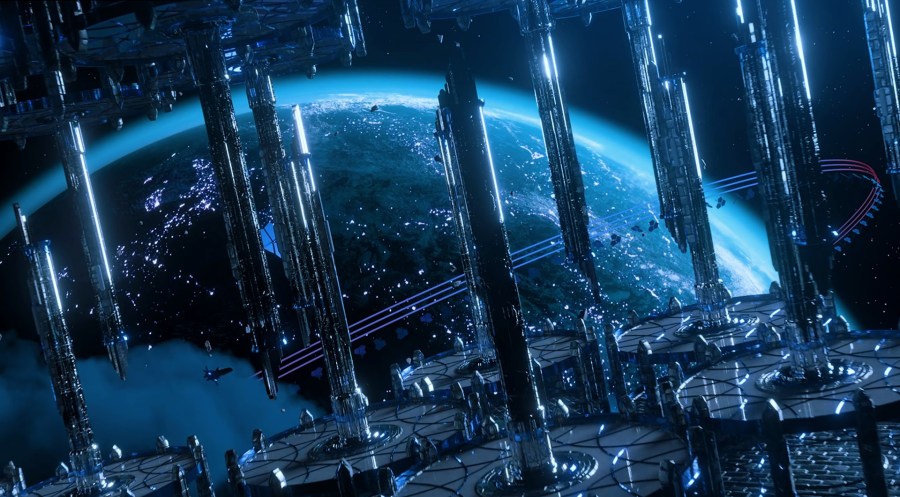
The darkness did not persist. Lights came on, dimly at first, then gradually brighter, to illuminate the embarkation compartment beyond the airlock, and Anna reached up to turn off her helmet light. She heard as much as felt a rush of warm air blow into the room from the wall vents, though it would take a while to displace the cold that permeated everything. At least that meant there was atmospheric pressure, so the safety systems must have sealed off the depressurized parts of the ship. A slowly pulsing red light over the far hatchway competed with the persistent alarm for her attention, and after each alarm tone, a cool, calm, female voice rang over the speakers.
“Attention. Hull breach detected. Safety interlocks engaged. All personnel don emergency apparatus and report to duty stations.”
Had that alert been sounding repeatedly for… how long had it been? Nine weeks? Ten?
“Attention. Hull breach detected. Safety interlocks engaged. All personnel…”
Upon returning to the starship, a grim discovery awaits Anna and her crew, along with the realization that outrunning the oncoming Orta ship will be futile. With time running out, all options appear bad, but that has been the case since first being marooned on the alien world of Kepler 62f. Can quick thinking and clever strategies save them now, or are they about to find out what happens to prisoners of an alien species?
Go click that button to find out! And after you’ve read the scene, if you liked it, let me know! Hit that Like button, and to be notified when the next scene is out, hit that Follow button too!
(Caution: the opening paragraph of this scene contains a major spoiler for those who have not read the previous scene, so if you have not yet read that one, please consider going back to do so now)
🚀
With the inner airlock hatch opened, Anna floated Jaci’s lifeless body into the warmth of the lander’s crew compartment. Laxmi awaited her on the other side and gently took Jaci from Anna, quickly and efficiently moving him to a stable surface to remove his helmet. With a gasp of equalizing pressure, Anna removed her own, her vision still blurred by tear droplets clinging to her eyelashes. She watched Laxmi cut away Jaci’s e-suit to reveal the wound in his abdomen, red, raw, and angry, a deep two-inch gash of frozen blood and vacuum-cauterized flesh. She had to look away and focus on her breathing for a moment.
“Anna, there’s nothing more you can do for him now. He was exposed for a good ten minutes, and even without the other trauma, that would not have been survivable.”
I told you at the top of the page that there would be a major spoiler, so if that paragraph surprised you, well, you have only yourself to blame! Now do yourself a favor, and go back and read the previous scene… actually, you need to read at least the previous two scenes for the lead-up to this one. Of course, I’m assuming you’ve been reading all the scenes up to this point, right?
So yes, dear reader, it appears a beloved character has met with an awful fate, and the few remaining survivors are left to pick up the pieces and deal with the emotional fallout. How many have we killed off now? Two that we know of — Takashi much earlier in the story and now Jaci — and one more that we strongly suspect. Remember David? He remained behind on Aniara to mind the shop while everyone else piled into the shuttle to go investigate the ring station when they first arrived, and he hasn’t been heard from since. He could be just hanging out, enjoying some me-time after three years cooped up in a small space with this crew, but it has been a couple months with no word, so yeah, not looking good.
That leaves only Anna and Laxmi from the original crew, plus Ca-Tren whom they’ve picked up along the way, and now they are finally — finally! — enroute back to Aniara. Where, no doubt, they will discover David’s fate.
I really do want to get into some discussion about the lander that Anna remotely piloted to come pick them up, and in which they are now heading back. This is a spacecraft fundamentally different from the shuttle they first set out in to investigate the station. The shuttle, remember, was really intended for ship-to-ship orbital transfers, but in a pinch it was capable of atmospheric re-entry and landing, which turned out to be a very useful feature. However, once down on the surface of a high-G world, it isn’t capable of boosting itself back into orbit without being strapped onto some big rocket, even if it hadn’t sustained major damage during the crash-landing.
The lander, on the other hand, is just what it sounds like: a vehicle intended for trips down to the surface, and then back. This thing has only a very small crew compartment and a very BIG engine, with most of its gross mass being fuel, and it is capable of continuous high specific impulse and high thrust operation, something today’s rockets can’t actually do. Don’t worry about what those things mean right now — I’ll go into more detail in a future blog post where we can geek out properly — but suffice it to say these twin properties mean the lander can choose to ignore normal orbital maneuvers and make a straight-line brachistochrone between two points, albeit at a greatly increased fuel consumption rate. In other words, Anna and crew can get back to Aniara, 22,000 kilometers away, in about 50 minutes of 1/2-G thrusting instead of spending a day and a full orbit to raise themselves 100 kilometers higher and fall back to Aniara‘s position.
So, go read the scene, and then if you haven’t already, hit that Follow button, and hit those Like buttons, or better yet, leave a comment!
…heat wave inundates most northern (tribes / communities / cities) today, while in the southern (land / island / continent) fierce storms lash the eastern coast. Storm surge overtopped the inner seawall in Ka-Voniss, flooding the second ring of the city, forcing millions of residents (Li-Estl’s note: this number cannot be right; there are no more than several tens of thousands of Kwakitl in the entire world today) to flee the city and seek higher ground. The (elder / leader / mayor) promised to build a higher wall and install pumps. Elections are in two (unknown).
Yes, this is a short one. Not so much a standalone scene, but the translation of the ancient broadcast which Anna and Laxmi now are reading for the first time, with interpretation from Jaci and Li-Estl.
A news broadcast from 1200 years ago!
Some of the ancient terminology is unfamiliar to Li-Estl, as they don’t have concepts like cities or mayors anymore, so the translation includes rough English approximations.
What do you think the news broadcast reveals? What does it tie to that we’ve seen in earlier scenes?
In other news, this represents my first words for 2019’s NanoWrimo, so I am now 630 words in for the month. Not that far for what is technically the 2nd day, but I’m good with it, and I’m also not necessarily done yet for today. It’s early still! Who knows, I might even post another scene this weekend, breaking my usual once a week (or once a month) habit.
We dream of reaching the stars. Indeed, it’s at the core of what I’ve been writing, and the same is true for many other science fiction authors. It’s also the subject of intensive research by some fairly serious scientists, even if they don’t quite get the billing and notoriety of NASA projects focused right here in our own Solar System.
But is it truly possible?
I like to think so, but I also understand that the challenges are incredibly daunting, more so than the majority of interstellar-themed science fiction stories would have us believe.
Bestselling author Kim Stanley Robinson tackles the challenges of so-called generation ships, in which people will be born, live, and die during the voyage, and only the grandchildren of the original astronauts will be alive at journey’s end in his 2015 novel Aurora. It’s a great read, and I highly encourage you to check it out. I won’t spoil it for you by talking about his conclusions in the novel.
But Robinson also wrote a blog post discussing his thoughts on the various challenges faced, Our Generation Ships Will Sink, and perhaps the title gives it away. He goes into some detail about the issues faced with biological, ecological, physical, sociological, psychological… lots of logicals there. Even upon arrival, the problems don’t cease.
Robinson’s article is a great read, but if you want a nicely wrapped up synopsis of it, I recommend Richard Rabil Jr’s Stars Beyond Our Reach, linked at the beginning of this post. Rabil is a technical writer, who writes both fiction and essays on subjects as diverse as technology and faith, and he tackles many interesting subjects on his blog (which I’ve only just discovered, but so far it’s very promising). He also does a great summary of the evolution of science fiction as a genre, another post I can strongly recommend.
If, like me, you are fascinated by realism in our quest to reach the stars, Rabil’s summary is a good place to start.
In the year of ’39 assembled here the volunteers,
In the days when lands were few;
Here the ship sailed out into the blue and sunny morn,
The sweetest sight ever seen.
Lately I’ve had this song running through my head, pretty much on constant repeat. It’s an old song, first released in 1975 on the album A Night at the Opera by Queen.
And the night followed day,
And the storytellers say
That the score brave souls inside
For many a lonely day sailed across the milky seas,
Ne’er looked back, never feared, never cried.
At first it seems to be telling a relatively ordinary story. Volunteers set sail in a ship for a dangerous journey. Is it 1939? Is this something to do with World War II? It’s not really clear yet.
Don’t you hear my call though you’re many years away,
Don’t you hear me calling you;
Write your letters in the sand
For the day I take your hand
In the land that our grandchildren knew.
Wait, what? The land that our grandchildren knew? Ok, there is something odd going on here. And what’s this about being many years away? The song seems to be playing around with time.
In the year of ’39 came a ship in from the blue,
The volunteers came home that day,
And they bring good news of a world so newly born,
Though their hearts so heavily weigh;
For the Earth is old and grey,
Little darling went away,
But my love this cannot be,
For so many years have gone though I’m older but a year,
Your mother’s eyes, from your eyes, cry to me.
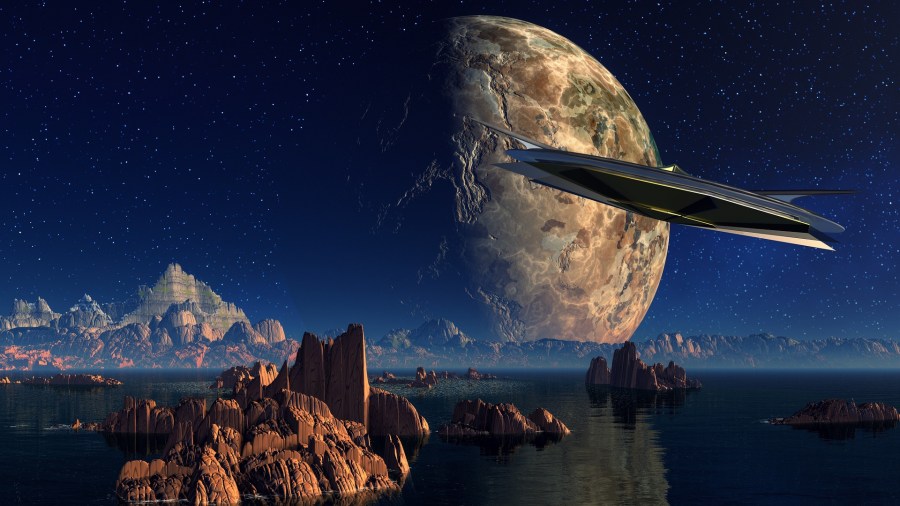
Right, this is definitely not an ordinary ship sailing ordinary seas, and time is certainly being twisted. The volunteers bring news of a new world, while the Earth is old and grey? We’re talking about space travel, aren’t we? In fact, we’re talking about interstellar travel.
It’s definitely not 1939.
Many music lovers might have been confused by this song, but by now it should be obvious to readers of this blog what’s going on here. For astronauts to travel far enough to discover another world (“so newly born”), one capable of replacing the “old and grey” Earth as humanity’s home, and return back with the news “older but a year,” they must have traveled very fast indeed. Perhaps even approaching the speed of light?
At speeds this fast, the theory of special relativity tells us (and experimental research has shown) that odd things happen with time. Time appears to slow down for the traveler, at least relative to the stationary observer, so that by journey’s end the traveler will have aged far less than those who stayed home.
In the year of ’39 assembled here the volunteers
2139, perhaps? 2239? It’s not completely clear.
In the year of ’39 came a ship in from the blue,
The volunteers came home that day
Not the same ’39, but 100 years later. 2239? 2339?
For so many years have gone though I’m older but a year
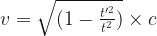
As it happens, given the parameters of the song, we can calculate how fast the ship was traveling, and thus how far away they went, and perhaps even speculate what star they visited! This is because, despite being such a non-intuitive phenomenon, time dilation due to relativistic effects is well understood, and there is an equation to calculate it.
Where:
t’ = dilated time
t = stationary time
v = velocity
c = speed of light
We want to know the ship’s velocity, so let’s parse this out (like traveling back in time to algebra class!):
Ok, let’s plug in some numbers! To keep things simple, we’ll express velocity as a percentage of the speed of light, and time in years, even though normally in physics equations velocities would be meters per second and time in seconds. But at this scale, those would be some big numbers, so we’re going to assume that c=1, and that v therefore is a percent of c.
In order for 100 years to have passed on Earth while only 1 year passed for the astronauts, the ship had to be traveling approximately 99.995% of the speed of light. That is some extreme time dilation, and so that is some extreme speed. Quite the starship!
Time isn’t the only thing dilating here, as traveling at these speeds does some interesting things to the fabric of space as well. Distances ahead of the travelers will appear to shrink somewhat, though even at this high fraction of the speed of light, it’s a minimal effect. Add a few more 9s to the significant digits, however, and it gets very strange indeed.
Meanwhile, though, our travelers have spent a year journeying at very close to the speed of light. How far have they gone? One light-year?
Oh no. They’ve gone much farther than that. The distance traveled is at a speed relative to time for the stationary observers waiting patiently back on Earth, so our starship has traveled a hundred light-years, though it seems to the astronauts to take only one year to do so.
So, what star might they have visited to find a “world so newly born” to which humanity could relocate? First off, this was a round-trip, so with half the time spent journeying out and half spent returning, that would imply they went no more than fifty light-years away (“no more than,” I say, as if this is no big deal, but fifty light-years is a very big deal). Gliese 163 is 49 light-years away and has one potentially habitable world, but it’s not considered an absolutely prime candidate.
Let’s assume, for a moment, that our starship took a little bit of time to accelerate and then decelerate on its journey, so that instead of 50 light-years, perhaps it really only traveled about 40 light-years away.
Trappist-1 is a cool red dwarf star 39.6 light-years away, and it has seven temperate and terrestrial planets, four of which are considered potentially habitable even by conservative estimates. Trappist-1 is obviously a prime candidate for finding life, or at least worlds on which humans could live, and being at about the right distance, is also a prime candidate for our volunteers on their desperate and lonely journey.
Not that this provided much consolation to our narrator, who returns to Earth to find his wife long dead, and only a memory of her in the eyes of his (presumably centenarian) daughter (or granddaughter?).
Your mother’s eyes, from your eyes, cry to me.
’39 was written by Brian May, lead guitarist for Queen, in 1975. May, as some of you may know, is also an accomplished astrophysicist, and while the planets of Trappist-1 had not yet been discovered in 1975, he certainly understood the effects and impacts of time dilation on travel at relativistic speeds. May studied physics and mathematics up through the time when his music career began to skyrocket to success, though due to focusing on music after that point, it took him 37 years to complete his doctoral thesis (A Survey of Radial Velocities in the Zodiacal DustCloud), finally earning his PhD in 2008. He was Chancellor of Liverpool John Moores University from then until 2013, and he was a science team collaborator for the NASA New Horizons mission to Pluto.
Not just a fantastic guitarist and songwriter, but a serious scientist!
Don’t you hear my call though you’re many years away,
Don’t you hear me calling you;
All your letters in the sand cannot heal me like your hand,
For my life
Still ahead
Pity me.
Final note: Although Freddie Mercury is far more well-known as lead vocalist, it was Brian May who sang the lyrics for the studio version of ’39 (though Mercury sang for most of their live performances).
’39 from the album A Night at the Opera by Queen, 1975
Songwriter Brian May, copyright EMI Music Publishing, Sony/ATV Music Publishing LLC
Special thanks to E=mc2 Explained for breaking down the physics of time dilation for us laypeople.
Books, games, music, and life — filtered through the mind of a writer, drummer, and philosopher who thinks too deeply about all of it. If it moves something in your chest, I'm interested.











 Matt Fraser