There are things worth carrying.
And things worth running from.
Both ways, arrival is complicated.
Stay tuned.

There are things worth carrying.
And things worth running from.
Both ways, arrival is complicated.
Stay tuned.

It’s been a while.
Longer than I meant it to be, and longer than I would have liked. But stories have a way of waiting for you when you need to step away for a bit, and this past year has been very good at insisting on that. Between a few life-sized plot twists, a move to a new city, and a handful of real-world chapters I hadn’t exactly planned for, this little corner of the internet grew quiet.
But I never stopped thinking about stories.
Some of you remember that, for a long time, I’d been sharing scenes here from The Silence of Ancient Light — a big, serious, slow-burn science fiction project that’s grown into something rather sprawling and strange and dear to me. That story is still very much alive. I haven’t abandoned it. If anything, I’ve learned that sometimes a story needs a little space to breathe, so that when you return, you can see it more clearly.
And while I was letting that one simmer, something unexpected happened.
I began writing a very different kind of story.
It started as a kind of creative palate cleanser — lighter, smaller in scope, faster on its feet. A story more interested in voice and character than in cosmic philosophy. Something that didn’t take itself quite so seriously. And somewhere along the way, that little side project stopped being little. It found its own rhythm. It’s own momentum. Its own sense of fun.
If you read To Wander the Silent Dark, you may remember that I had a bit of fun leaning into rhythm, voice, and the sheer pleasure of language. That, it turns out, was a clue. This new project carries a little of that same energy, though in a very different form.
Right now, I’m deep into the editing stages of that new work. It’s novella-length, quick-moving, and deliberately playful in ways my longer projects rarely are. I’m not quite ready to share details yet — not the title, not the characters, not the plot — but I wanted to let you know that something new is taking shape.
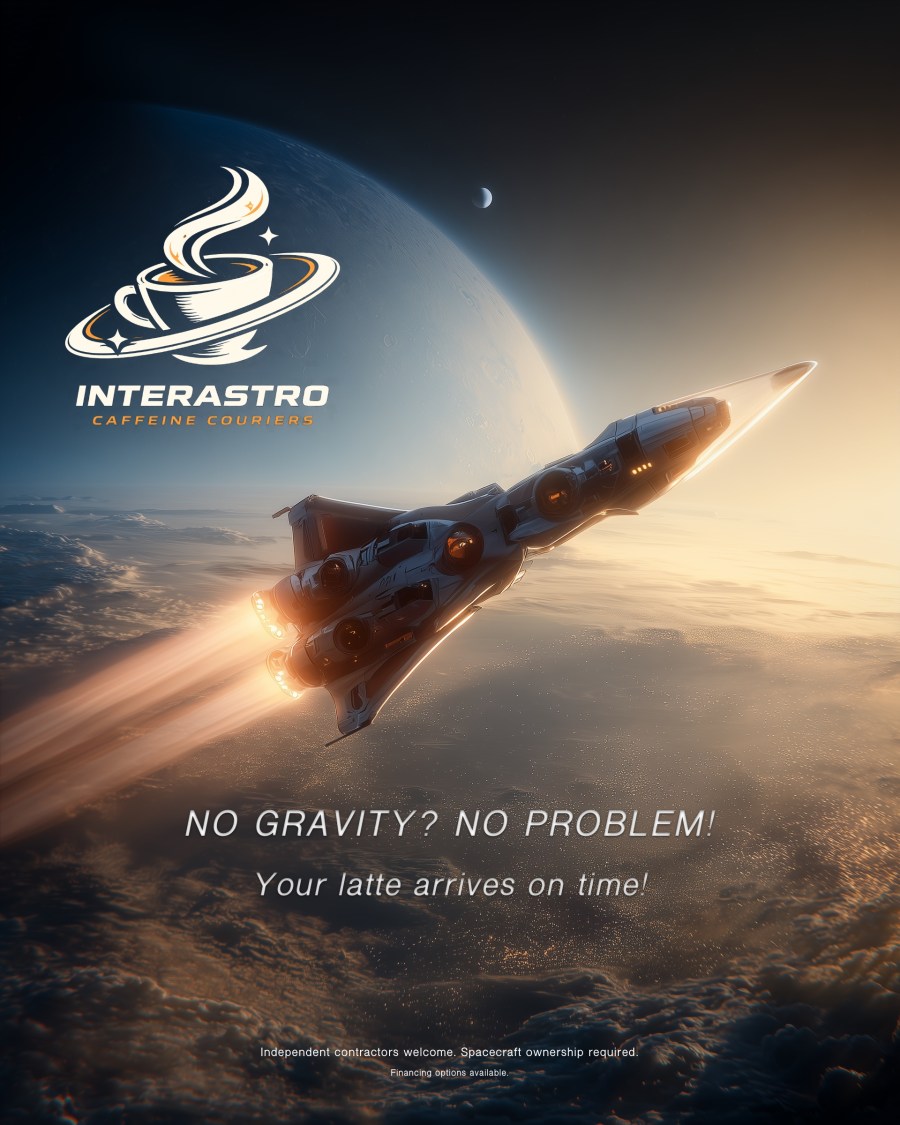
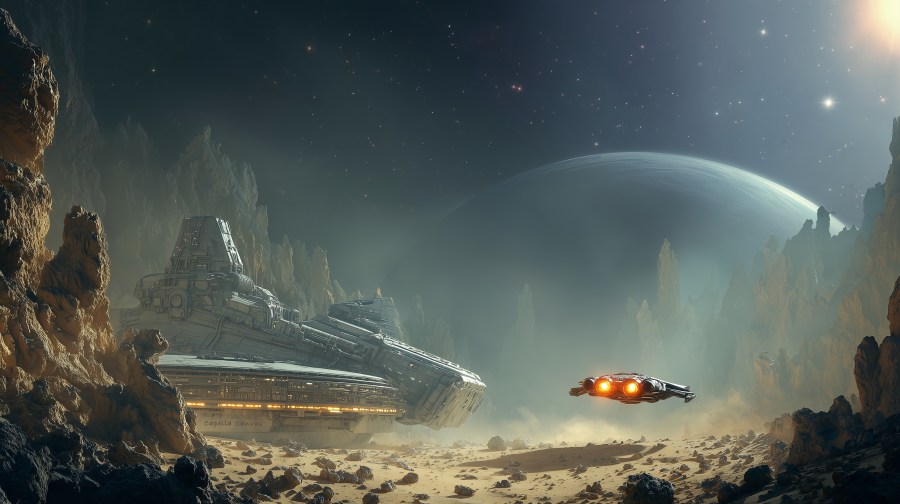
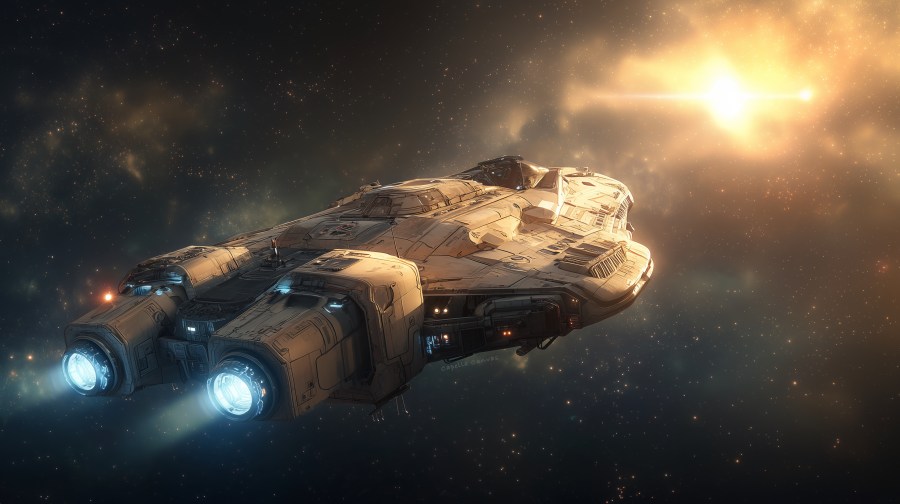
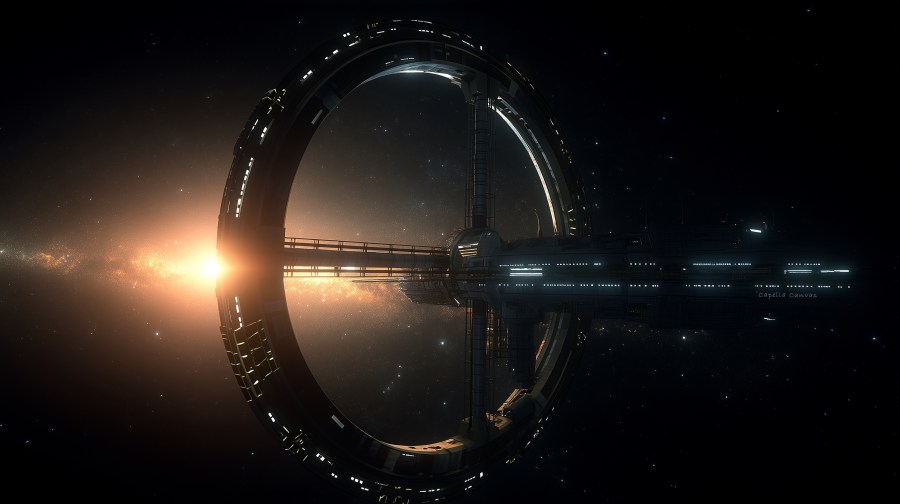
The image below is a small, spoiler-free glimpse of the world it inhabits.
More soon.
And thank you for being here, even when I’ve been quiet.

(The Silence of Ancient Light, continued)
🚀
Small wonder the room was devoid of air. The chamber clearly had been meant as some sort of view lounge, with larger than usual windows providing unparalleled views outside the station, but those windows had shattered in some micrometeorite collision long before, perhaps hundreds of years before Anna set foot inside. As she floated deeper into the room, glints of reflected light sparkled from chunks and beads of polycarbonate embedded in the interior wall opposite the windows, providing a clue as to the force with which the collision must have occurred. Similar windows manufactured for use on human spacecraft could easily withstand the impact of a bullet fired from a handgun, but even the most powerful rifles achieved muzzle velocities less than half this station’s speed as it orbited the planet. Over a thousand years earlier, Anna recalled, there had been a shooting war around these parts. How many spent bullets and projectiles from that conflict remained in orbit, speeding endlessly around the planet, until eventually they met up with some other object speeding the other way, such as this station window? After all this time, would their orbits have decayed enough to sink down toward the planet? At forty-thousand kilometers altitude, there was no atmospheric drag to slow them down.
Could a stray thousand-year-old bullet have been what hit the shuttle? Or Tak, all those months ago?
Read more at
(1,254 words; 5 min reading time)
🚀
Are you a fan of The Expanse? Of course you are, silly question. Obviously, so am I. But one question that I had, repeatedly, while reading the books and perhaps even more especially while watching the show, had to do with all those PDC rounds fired off by the Rocinante and other warships. You recall the Point Defense Cannons, firing 40mm armor-piercing slugs at a rate of thousands of rounds per minute per gun in efforts to shoot down incoming torpedoes and missiles. Each ship might sport dozens of such guns, computer-controlled, all firing at once to lay down a “curtain of steel.”
That’s a lot of steel slugs, all expelled with a muzzle velocity that is probably close to 2,000 m/s, fired off in all sorts of directions. To say nothing of the railgun rounds, heavier tungsten slugs expelled at much higher velocities, though not in as great quantities. And most of those PDC rounds don’t actually hit any targets, since their design is more about filling space with steel.
So what happens to the expended rounds?
Basic Newtonian physics tells us that in a vacuum those slugs will continue their momentum essentially forever, or until they finally do come up against some other object, such as an asteroid or moon, not to mention a satellite or spacecraft that is unlucky enough to be on a crossing trajectory at the wrong moment. At 2,000 m/s, plus whatever velocity the ship had at the moment of firing (depending upon the gun angle relative to the ship’s vector), the rounds don’t have enough momentum to escape the Solar System, so they aren’t flying off into interstellar space.
No, instead, they’re basically orbiting the Sun forever, until they happen to pass close enough to some larger body with a gravity well, such as a planet, at which point they either are captured into orbit around the planet or burn up in its atmosphere.
Space is big, as Douglas Adams once said. Really, really big. And it’s mostly empty. So, we can take our chances and just assume that the odds of one of those spent slugs crossing our path are very low. Of course, there are hundreds of thousands, or even millions, of these slugs flying around in this scenario, on essentially unpredictable paths.
No doubt it will become someone’s job to chart those paths, and some agency’s mission to publish notices of hazards to spacefarers.
Now imagine this shooting war all happened in orbit around a planet, as opposed to somewhere out there in interplanetary space. Again, hundreds of thousands of rounds fired from ships that are already traveling 3,000 m/s themselves, because that’s their orbital speed. Depending upon whether these shots are fired prograde, retrograde, transverse, or otherwise, chances are they won’t stay in the same orbit as the ships that fired them.
But they will stay in orbit.
Oh, some will degrade enough to be caught in the atmosphere, and none of them are going to make it to the ground. But none of them are likely to escape the planet’s sphere of influence, either, so they may be in equatorial or polar orbits, they may be in higher or lower orbits, their orbits may be highly eccentric, but they will be in orbit.
And they will still be there a thousand years later, when some unsuspecting astronaut comes along to investigate the sad ruins of an ancient space station, a relic of that forgotten war.
header image credit: Karen Nyberg / nasa.gov under NASA Media Usage Guidelines

We’ve just seen the coinage of a new word that denotes an entirely novel category of planets. Out of research at the University of Cambridge comes a paper on a subset of habitable worlds the scientists have dubbed ‘Hycean’ planets. These are hot, ocean-covered planets with habitable surface conditions under atmospheres rich in hydrogen. The…
‘Hycean’ Worlds: A New Candidate for Biosignatures? — Centauri Dreams — Imagining and Planning Interstellar Exploration
Paul Gilster of Centauri Dreams writes not fiction, but analyses and discussions on the latest findings in deep space research. He unabashedly is a proponent of efforts toward interstellar travel, frequently writing about the reasons we should invest in such a future. In this piece, he discusses a new category of exoplanets, Hycean worlds, worlds which may have water surfaces under hydrogen atmospheres, and which could potentially support life under a wider range of stellar and planetary conditions than Earth-like worlds.
Within my own fictional imaginings, we have the Orta, a seemingly water-breathing species, though we don’t yet know where they come from. Perhaps their home planet is a Hycean world like those described here?
Read. Play. Watch. Listen .
Supporting Your Career Journey
Almost Meaningful
Observations and opinions of a crime-fiction crazy bibliophile and addicted cruciverbalist.
Where brevity meets depth, and verse sparks change.
Celestial Visions for Boundless Worlds
The Musings of a Writer / Editor in Training
Spit mixed with dirt - Muddy words flow
PUBLISH STORIES.
Collection of a creator
Stories and photos from Scotland
Illustrations to make you smile, laugh, and sometimes make you see things from a different perspective 😉
Author site for writer Frank Merceret
Science | Sci-Fi | Gaming
Author, Podcaster, Filmmaker
Horror, Science Fiction, Comic Books and More
Join the Raga Squad!
Hi, I'm Avisha Rasminda Twenty-Two years old, Introduce Myself As A Author , Painter , A Poet.