
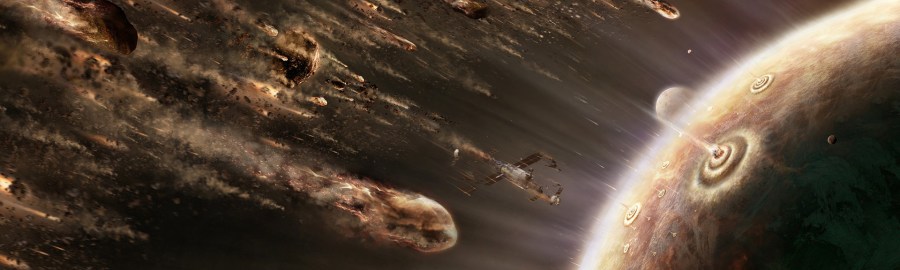
(The Silence of Ancient Life, continued)
🚀
The blue-green expanse of ocean covered the planetary disc, horizon to horizon, broken only by white wisps of cloud cover and the approaching dark terminator of night. The dissipating cyclone spun its radial ferocity in trailing spirals, peaceful grace from orbit’s distant remove. Where the blue and white of the planet met the blackness of space, a hazy glow hinted at the atmosphere, razor thin from this altitude. For a moment Anna flashed back to her view of this scene upon first arrival, months ago, when all seemed full of promise.
Intermittent bright flashes and sparks interrupted the velvety darkness around the planet, a silent light show of shrapnel collisions against the backdrop of the disintegrating ring station behind her, yet her focus remained on the solitary human figure spinning away toward the distant surface, limbs unmoving. She held on to the small antenna that saved her from a similar fate, legs dangling, her other arm still outstretched toward Jaci in vain, fading hope. Her heart thumped rapidly in her chest, her breath fogged her visor only to have the oxygen flow clear it. She still couldn’t quite believe that he had slipped from her grasp, that he was gone.
Read more at
(1,918 words; 7 min 40 sec reading time)
🚀
And thus begins Chapter 11 of The Silence of Ancient Light, with dashed dreams and fading hope as disaster unfolds all around. As you’ll recall (spoiler alert! If you haven’t yet read through the previous scene, you must do so before proceeding with this one! Indeed, you should do so before reading further in this blog post), the previous chapter ended with the loss of a major character, and the new chapter begins with our precious few survivors hanging on by the most slender of supports — a bent antenna, anyone?
The shockwave from the severed space elevator cable has arrived at the ring station in orbit, followed closely by the lifting segments of the cable itself. Recall that the cable was severed near its base at the surface of the planet, 41,100 km below the station’s orbital altitude. Approximately 10,000 more km of cable extend farther out from the station, with a counterweight at the top end. That counterweight, with the same radial velocity as the station and the enter cable, is thus orbiting faster than a free object at that altitude would. If the elevator cable were not holding it down, it would spin off to a higher orbit, or perhaps escape the planet’s gravity well entirely. Thus, that centrifugal force on the counterweight’s mass is what holds up the cable, relieving the station of the need to support it. If the cable is no longer tethered at ground level, what happens? We explored this first in my post Is This Plan B? Or Plan C? (Chapter 10 Begins)
The ring station orbiting Kepler 62f once had twelve elevator cables between it and the planet’s surface, set at equidistant intervals around the equator. This was once a society very busy with ground-to-orbit commerce! Today, most of these cables are in disrepair, or in ruins, and parts of the ring station are ruined as well. However, as we know now, at least one still works, or did up until this part of the story.
If the cables are equidistant around the globe, and the station’s geosynchronous altitude is 41,100 km, and the planet’s diameter is 17,862 km, then basic trigonometry tells us that the distance between elevators at the station is 26,196 km. When the severed cable lifts, it doesn’t lift straight up, due essentially to Coriolis forces acting upon its length. Instead, it will tend to precess westward, trailing behind the rotation of both the planet at its base and the station at its top. Hypothetically, if the cable were to precess westward in a straight line, it would impact upon the next cable to the west, most likely severing that one as well. However, its more likely that it will tend to curl up as it lifts, which is not likely to be beneficial to the structural integrity of the carbon nanotube filaments that are its major strength component (carbon nanotubes have amazing longitudinal strength, but could easily be shattered by perpendicular shear forces, which is why the cable has an outer protective shell).
When this curling cable ultimately reaches the station, it likely is no longer a single component, but will already have been shattered into multiple segments. Some of these will fall back to the planet, causing massive damage along the equator (mostly ocean, but certainly tsunamis will result), but others will indeed impact the station for a good portion of its length. Meanwhile, the counterweight is still lifting on the station at the point where the cable meets it, and without the cable providing a downward force, that counterweight will likely pull the station apart, too.
Not a good place to be when it happens. Now imagine having to attempt a rescue in the midst of everything falling apart into millions of razor-sharp fast-moving shards of shrapnel around you.
Reminder, friends: hit that Follow button! If you’re a WordPress user, you can receive notifications of new updates in your WordPress Reader. Otherwise, you can sign on to my mailing list to receive a notification in your email inbox when there’s a new post (I will not use your email address for anything else, ever, nor will I share it with anyone else, ever). And hit those Like buttons, or better yet, leave a comment!
header image credit: user:AndreyС / pixabay.com via Pixabay License


 Matt Fraser